


 Sea Beach
A patient books an appointment online. But what happens after that?
Can the hospital access the patient's previous records? Does the doctor have the necessary information? Can the laboratory receive test requests? Are prescriptions, billing, pharmacy operations, and follow-up appointments connected?
For many healthcare providers, digital transformation still begins and ends with online appointment booking.
While online scheduling is valuable, healthcare operations involve much more than managing appointments.
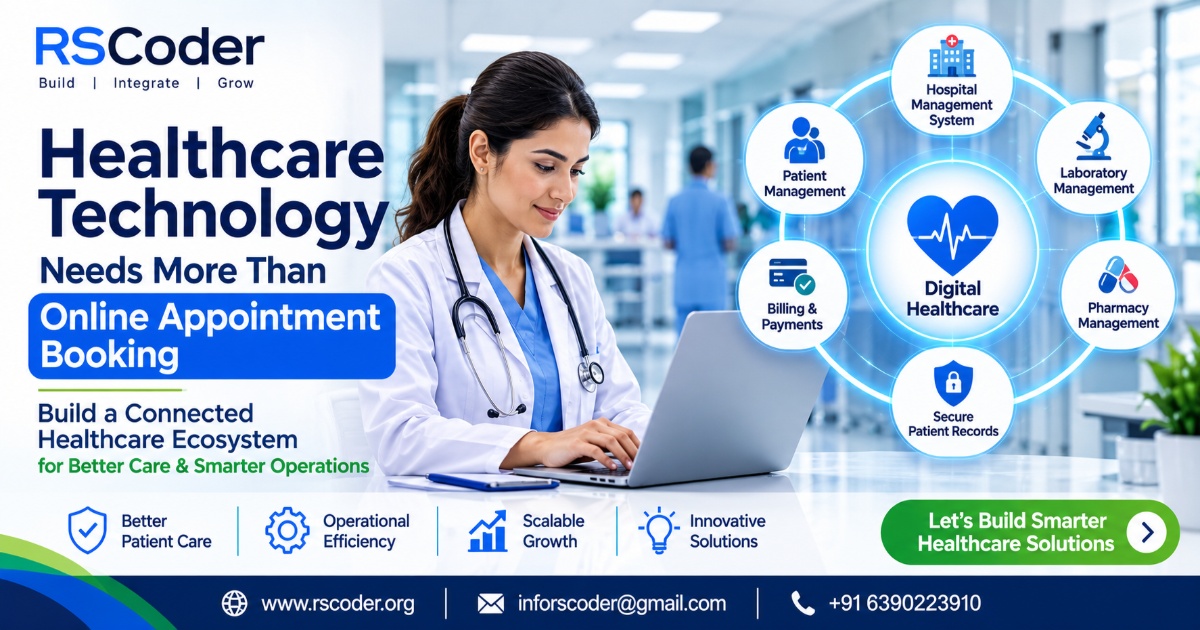
Hospitals, clinics, diagnostic laboratories, pharmacies, and healthcare networks depend on multiple departments working together. When these departments operate through disconnected systems, the result can be duplicated work, fragmented information, administrative delays, and an inconsistent patient experience.
This raises an important question:
Are healthcare providers simply putting their services online, or are they actually building connected digital healthcare systems?
The next stage of healthcare technology will be about connecting the entire patient journey and improving how healthcare organizations operate.
1. Healthcare Is an Ecosystem, Not Just an Appointment Calendar
Consider a typical patient visiting a hospital.
The journey may involve:
-
Online appointment scheduling
-
Patient registration
-
Doctor consultation
-
Medical history and record management
-
Laboratory investigations
-
Diagnostic reports
-
Pharmacy and prescription management
-
Billing and payment processing
-
Follow-up appointments
Each activity generates information that may be important for another department.
If these processes are managed through separate applications, spreadsheets, or manual records, staff may spend unnecessary time transferring information between systems.
A connected healthcare management platform can bring relevant workflows together.
For example, when a doctor requests a laboratory investigation, the system can make the order available to the appropriate laboratory workflow. Once the report is approved, authorized users can access it through the appropriate patient record.
This creates a more coordinated operational process.
The objective is not to digitize every activity independently. It is to make the entire healthcare ecosystem work together.
2. Electronic Health Records: Beyond Digital Patient Registration
Patient information is one of the most important components of healthcare operations.
However, collecting basic patient details during registration is not the same as maintaining a useful digital health record.
Electronic Health Records (EHR) and Electronic Medical Records (EMR) systems can help healthcare organizations manage relevant patient information in a structured format.
Depending on the system and its intended use, this may include:
-
Patient demographics and medical history
-
Consultation notes
-
Diagnoses and treatment records
-
Prescriptions
-
Laboratory and diagnostic reports
-
Allergies and relevant clinical information
-
Previous visits and follow-up details
A well-designed system can help authorized healthcare professionals access relevant information more efficiently.
It is equally important to implement role-based access, appropriate consent mechanisms, audit trails, secure storage, and applicable data-protection requirements.
Healthcare data is sensitive. Digital convenience must never come at the expense of patient privacy.
The real value of digital health records is not simply storing information. It is making the right information accessible to the right people at the right time.
3. Hospital Management Systems: Connecting Departments Under One Platform
Hospitals are complex organizations.
Their operations may include patient registration, appointments, doctors, nursing teams, laboratories, pharmacies, billing, inventory, and administration.
A Hospital Management System (HMS) can help coordinate these different operational areas.
Instead of managing each department independently, healthcare providers can develop connected workflows.
For example:
| Hospital department | Digital technology capability |
|---|---|
| Reception | Patient registration and appointments |
| Doctors | Consultation and clinical records |
| Laboratory | Test requests and report management |
| Pharmacy | Prescription and inventory workflows |
| Billing | Invoices and payment tracking |
| Administration | Reports and operational dashboards |
| Nursing | Patient care coordination and relevant records |
The exact features depend on the hospital's requirements.
A properly planned HMS can improve operational visibility, reduce repetitive administrative work, and support more consistent information management.
However, successful implementation requires understanding how departments actually work before designing the software.
Technology should support healthcare professionals rather than force them into unnecessarily complicated processes.
4. Diagnostic Laboratories Need Connected Technology Too
Diagnostic laboratories play an important role in healthcare delivery.
Yet laboratory operations involve much more than uploading reports.
A diagnostic management platform may need to manage:
-
Test booking and patient registration
-
Sample collection and tracking
-
Test processing workflows
-
Result entry and verification
-
Report generation
-
Billing and payment records
-
Patient and referring-doctor access
-
Laboratory inventory and operational reporting
Consider a patient who visits a diagnostic centre for a blood test.
The laboratory needs to track the sample, associate it with the correct patient and test request, record the results, and make the verified report available through an appropriate channel.
When these processes are digitally connected, laboratories can improve workflow visibility and reduce avoidable administrative duplication.
This is where Laboratory Information Management Systems (LIMS) and Laboratory Information Systems (LIS) become important.
Their implementation should account for laboratory-specific processes, quality requirements, access controls, and validation needs.
5. Telemedicine: Healthcare Beyond Physical Hospital Visits
Healthcare accessibility is changing.
Digital platforms allow patients and healthcare professionals to communicate beyond traditional hospital environments.
Telemedicine solutions can support remote consultations, digital appointment management, prescription workflows, and follow-up coordination, depending on applicable rules and clinical requirements.
But a video consultation feature alone does not make a complete telemedicine platform.
A more comprehensive solution may include:
-
Patient registration and authentication
-
Doctor availability and scheduling
-
Secure consultation workflows
-
Relevant patient history access
-
Prescription management
-
Payment integration
-
Follow-up reminders
-
Consultation records
The challenge is to connect these features into a secure and convenient experience for both patients and healthcare professionals.
Telemedicine technology should also be designed around clinical suitability, professional responsibilities, patient consent, and applicable healthcare regulations.
6. AI in Healthcare: From Digital Records to Intelligent Workflows
Artificial Intelligence is creating new opportunities across healthcare technology.
However, its value should be measured by practical applications rather than marketing claims.
Healthcare organizations can explore AI-supported capabilities such as:
Administrative automation: Supporting appointment coordination, document classification, and routine administrative workflows.
Medical information management: Helping authorized professionals search and retrieve relevant information from approved documents and records.
Patient communication: Supporting routine enquiries, appointment reminders, and service information.
Operational analytics: Helping administrators identify trends in appointment volumes, resource utilization, and operational performance.
Clinical decision support: Carefully designed tools may assist qualified healthcare professionals with information and workflow support, subject to appropriate validation and oversight.
AI should not be treated as a replacement for medical professionals or independent clinical judgment.
Healthcare AI systems require particular attention to data quality, privacy, security, bias, validation, transparency, and human oversight.
The biggest opportunity is to use AI responsibly where it can support healthcare teams and improve operational processes.
7. Healthcare Integration: Why Connected Systems Matter
One of the biggest technology challenges in healthcare is making different applications communicate effectively.
A hospital may already have an HMS, a diagnostic centre may use laboratory software, and a pharmacy may operate a separate inventory platform.
Replacing every existing system is not always practical.
API integration and interoperability can help connect these systems where supported.
For example:
-
Hospital systems can exchange appropriate patient and service information with laboratory systems.
-
Payment gateways can connect billing with transaction records.
-
Pharmacy platforms can integrate with authorized prescription workflows.
-
Patient portals can provide access to relevant reports and appointment information.
-
Reporting systems can consolidate authorized operational data.
Healthcare interoperability standards such as HL7 and FHIR can also play an important role in structured health information exchange.
The implementation must account for data permissions, identity matching, consent, security, and compatibility.
The future of healthcare technology is not necessarily one application doing everything. It is the right systems communicating reliably with one another.
8. What Should Healthcare Providers Consider Before Investing in Technology?
Before selecting or developing a healthcare software platform, organizations should ask some important questions.
-
Which existing processes consume the most administrative time?
-
Are patient records accessible to authorized professionals when needed?
-
Can departments exchange information without repeated manual entry?
-
Does the platform support the organization's current and future workflows?
-
Are patient privacy, security, and access controls properly addressed?
-
Can the system integrate with existing healthcare applications and external services?
-
Is the technology scalable and maintainable as the organization grows?
Not every healthcare provider needs an expensive, all-in-one platform.
A small clinic may begin with appointment management, patient records, and billing. A multi-specialty hospital may require a much broader HMS with laboratory, pharmacy, inventory, and reporting capabilities.
The right technology investment starts with understanding the organization's actual operational requirements.
How RSCoder Can Help Build Connected Healthcare Solutions
At RSCoder, we believe healthcare technology should go beyond individual digital features and support connected business operations.
We provide website development, mobile application development, custom software solutions, API integration, and AI development services.
For healthcare organizations and technology businesses, relevant digital solutions can include:
-
Hospital Management Systems
-
Clinic Management Software
-
Patient Management Platforms
-
Online Doctor Consultation Systems
-
Pathology and Laboratory Management Systems
-
Pharmacy Management Software
-
Healthcare Mobile Applications
-
Appointment and Patient Portals
-
Custom Healthcare Software Integrations
Whether you are planning a new healthcare application, modernizing existing software, or connecting multiple operational systems, the development process should begin with your organization's needs.
Our focus is on building practical, scalable, and carefully planned digital solutions that support real operational challenges.
Planning to digitize your healthcare business beyond appointment booking?
Let's discuss how the right technology can support your next stage of growth.
Final Thoughts: The Future of Healthcare Is Connected
Healthcare technology has already made it easier for patients to book appointments, access information, and communicate with healthcare providers.
But appointment booking is only one small part of the healthcare journey.
The bigger opportunity lies in connecting patient records, doctors, laboratories, pharmacies, billing, telemedicine, and administrative operations through reliable digital infrastructure.
Healthcare organizations that approach technology strategically can create more coordinated workflows, improve information accessibility, and build digital experiences around the needs of patients and healthcare professionals.
The future of healthcare will not be defined by how many digital features a hospital offers.
It will be defined by how effectively those features work together.
Because better healthcare technology is not just about booking an appointment. It's about building a connected healthcare experience.
What do you think is the biggest technology challenge facing healthcare providers today: disconnected systems, patient data management, automation, or interoperability?
Healthcare digital transformation goes beyond appointment scheduling. Discover how hospital management systems, electronic health records, laboratory software, telemedicine, AI, and API integration are shaping connected healthcare.
Healthcare Technology Needs More Than Online Appointment Booking: Building the Future of Connected Healthcare