


 Sea Beach
India’s UPI ecosystem is entering a new phase. After years of keeping UPI Payments Gateway effectively free for consumers and most merchants, the National Payments Corporation of India (NPCI) has introduced a revised Merchant Discount Rate (MDR) framework for selected merchant transactions.
The important point: this does not mean UPI is becoming a paid service for consumers.
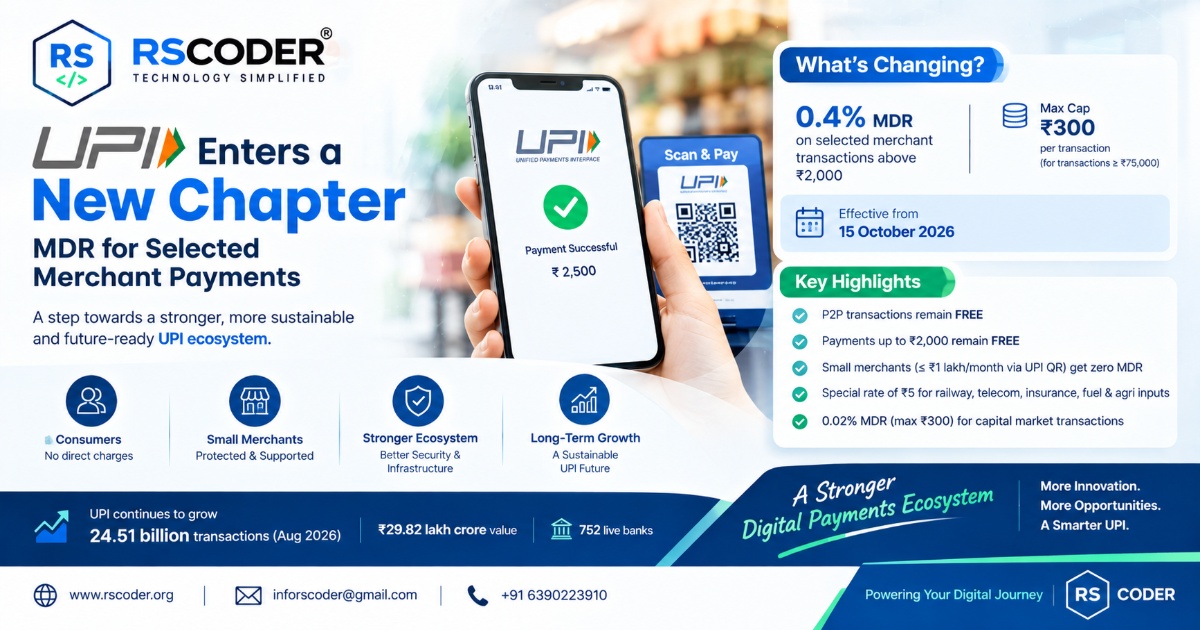
Under the new framework, which takes effect from 15 October 2026, MDR will apply only to specified Person-to-Merchant (P2M) transactions above ₹2,000. Person-to-Person (P2P) UPI transactions remain free.
What Is Changing in UPI?
The revised framework introduces a 0.4% MDR on specified UPI merchant transactions above ₹2,000.
For transactions of ₹75,000 and above, the MDR is capped at ₹300 per transaction. The charge is part of the payment ecosystem rather than a consumer-facing UPI fee.
For example:
| Merchant Transaction | Standard MDR |
|---|---|
| ₹2,000 | ₹0 |
| ₹3,000 | ₹12 |
| ₹10,000 | ₹40 |
| ₹50,000 | ₹200 |
| ₹75,000 | ₹300 |
| Above ₹75,000 | Maximum ₹300 |
These examples reflect the 0.4% rate and ₹300 cap under the announced framework.
Consumers Will Not Be Charged MDR
One of the most important clarifications is that MDR is not being imposed directly on UPI users.
The Ministry of Finance states that:
- P2P UPI transactions remain free regardless of amount.
- P2M payments up to ₹2,000 remain free.
- Small merchants covered under the zero-MDR framework remain protected.
- Merchants should not pass the MDR directly to customers.
- UPI apps are not permitted to add platform fees or hidden charges for these transactions.
So, if a customer scans a merchant's UPI QR code and pays for a product, the customer does not suddenly receive a separate “UPI MDR” bill.
Around 96% of Merchant Transactions Remain Unaffected
The scale of the change is also important.
According to the Ministry of Finance, approximately 96% of UPI Person-to-Merchant transactions will remain unaffected because they are either below ₹2,000 or covered by zero-MDR provisions. The ministry says MDR will apply to about 4% of merchant transactions.
That means the framework is targeted rather than a blanket charge across UPI merchant payments.
Small Merchants Get Special Protection
India's UPI growth has been strongly connected with small retailers, street vendors and neighbourhood businesses.
Under the new framework, eligible small merchants receiving up to ₹1 lakh per month through UPI QR codes under the P2PM category will continue to receive zero MDR treatment.
This is significant because payment costs can matter considerably for businesses operating on thin margins.
What About Essential Services?
The framework also provides different MDR treatment for certain sectors.
For specified transactions above ₹2,000 involving sectors such as railways, telecommunications, insurance, fuel and agricultural inputs, a flat ₹5 MDR per transaction applies rather than the standard 0.4% rate.
Capital-market-related payments, including certain transactions involving mutual funds, securities, stockbrokers and dealers, have a separate 0.02% MDR with a ₹300 cap.
This category-based approach shows that UPI's pricing framework is becoming more sophisticated as the ecosystem expands.
Why Is MDR Being Introduced?
UPI has grown into an enormous real-time payments network.
NPCI's official statistics show that in August 2026, UPI processed approximately 24.51 billion transactions, worth about ₹29.82 lakh crore, across 752 live banks.
Operating a payment ecosystem at this scale requires continuous investment in:
- Payment infrastructure
- Cybersecurity
- Fraud prevention
- Reliability and uptime
- Merchant onboarding
- Technology upgrades
- Customer support
- Expansion into new markets
The government has described the revised MDR framework as a mechanism intended to support the long-term sustainability, technological advancement and resilience of UPI.
MDR Is Not a Government Tax
Another important distinction is that MDR is not a government tax.
The Ministry of Finance states that MDR is distributed among participants in the payment ecosystem, including banks and payment-service providers, to support the operation and expansion of UPI.
This makes it different from a government tax collected directly from merchants or consumers.
What Does This Mean for FinTech?
The new framework could have implications beyond the payment itself.
FinTech companies, payment aggregators, banks and merchants may need to consider:
1. Better payment infrastructure
Payment platforms will need accurate transaction classification, settlement and reconciliation.
2. Smarter merchant systems
Merchant platforms may need better reporting around transaction categories, MDR eligibility and settlement amounts.
3. API-driven payment architecture
Modern payment applications increasingly depend on APIs for payment initiation, transaction status, reconciliation, refunds and reporting.
4. Better analytics
Businesses can use payment data to understand transaction patterns, settlement cycles and operational costs.
5. Stronger fraud prevention
As digital payment volumes continue growing, fraud detection, authentication and transaction monitoring remain important parts of payment infrastructure.
For companies developing FinTech platforms, these changes reinforce the importance of building payment systems that are secure, scalable, API-ready and adaptable to regulatory changes.
The Bigger Picture: UPI Is Maturing
UPI's next chapter is not simply about whether a transaction costs ₹0 or ₹12.
It is about how one of the world's largest real-time payment ecosystems can maintain scale, security, innovation and financial sustainability while keeping digital payments accessible.
UPI itself continues to evolve technically. NPCI describes UPI as an instant payment system built over the IMPS infrastructure, while its ecosystem increasingly supports merchant payments, international acceptance, mandates, credit-linked payment options and other digital-payment capabilities.
The MDR framework is therefore another development in a much larger evolution of India's digital-payment infrastructure.
What Businesses Should Prepare For
Businesses accepting UPI should pay attention to:
- Merchant category and eligibility
- Transaction-value thresholds
- Settlement reports
- MDR calculations
- Payment reconciliation
- Refund workflows
- Accounting integration
- Payment gateway/API integration
- Fraud monitoring
- Compliance updates
For software and FinTech companies, this is also a reminder that payment systems cannot be built as static products. They need architectures capable of adapting to changing regulations, transaction volumes and payment technologies.
Final Takeaway
UPI is not becoming “paid” for everyone.
From 15 October 2026, the revised framework introduces MDR on specified merchant transactions above ₹2,000, while P2P payments remain free, payments up to ₹2,000 remain free, and eligible small merchants continue to receive zero-MDR protection.
The bigger story is the continued evolution of India's digital-payment infrastructure — from a simple QR payment mechanism into a large, API-driven financial technology ecosystem.
For businesses building the next generation of FinTech, payment gateway, merchant, banking and financial applications, scalable technology and regulatory-ready architecture will become increasingly important.
At RS Coder, we build modern web and app solutions with API integration, payment technology, automation and custom software architecture for businesses moving toward the next generation of digital commerce.
UPI is entering a new chapter with MDR for selected merchant payments above ₹2,000. Explore the 2026 UPI changes, merchant impact, payment technology and the future of digital payments.
UPI Enters a New Chapter: MDR for Selected Merchant Payments