


 Sea Beach
Every business wants to automate something. But the next question is becoming more interesting: Should you automate tasks using traditional workflows, or start introducing AI agents that can understand information, make decisions, and take action?
Imagine two businesses.
The first business uses traditional automation. Whenever a customer submits an enquiry, the system automatically records the details, assigns the lead to a salesperson, and sends a confirmation email.
The second business uses an AI-powered agent. It can interpret the customer's enquiry, identify the nature of the requirement, retrieve relevant information, prepare a response, and recommend the next action based on predefined business rules.
Both businesses are using automation. But the way their systems operate is fundamentally different.
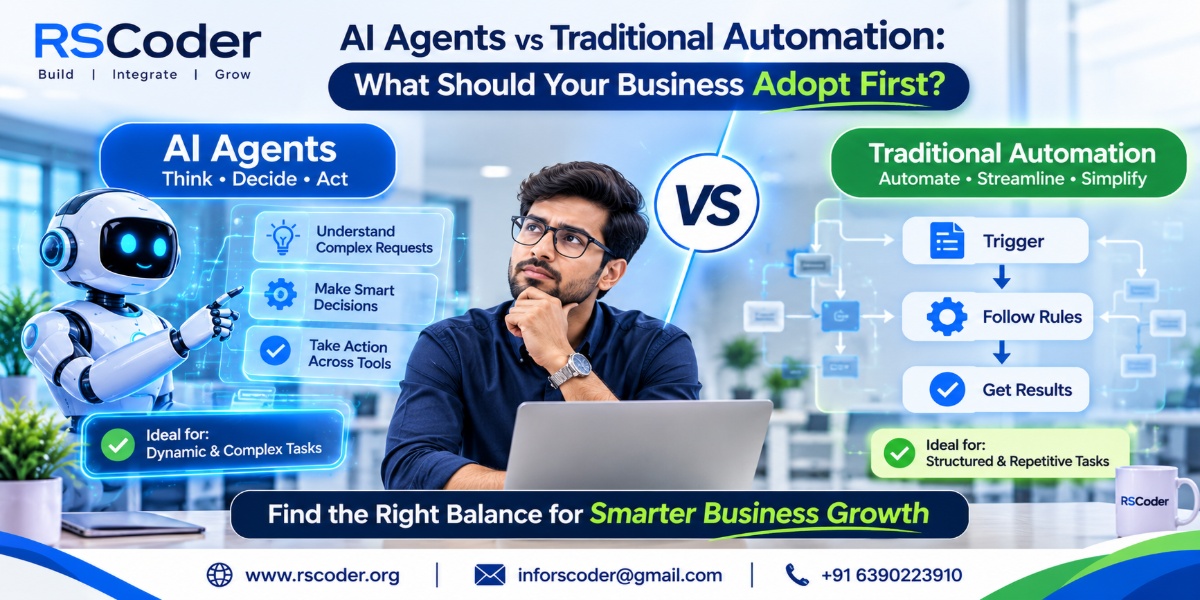
Traditional automation follows predefined instructions. AI agents can work toward a defined goal by interpreting information, selecting appropriate tools, and deciding which steps to take within their permissions.
This difference is creating an important technology decision for businesses in 2026.
Should companies invest in traditional automation first, or is it time to move directly toward AI agents?
The answer depends on the problem they are trying to solve.
1. Traditional Automation: The Foundation of Efficient Business Operations
Traditional automation has been helping businesses reduce repetitive work for years.
It works through predefined rules, triggers, conditions, and actions.
For example:
-
When a customer submits a form, create a CRM record.
-
When an invoice is generated, send it to the customer.
-
When payment is confirmed, update the order status.
-
When stock falls below a specified level, notify the inventory manager.
-
When an employee submits a leave request, send it for approval.
These workflows are predictable because the steps and conditions are defined in advance.
A traditional automation system does not need to understand the meaning of every situation. It simply follows the instructions configured by the business.
This makes it particularly useful for processes that are repetitive, structured, and rule-based.
Why businesses still need traditional automation:
-
Consistent execution of repetitive tasks.
-
Predictable workflows and outcomes.
-
Reduced manual data entry.
-
Easier monitoring and troubleshooting.
-
Lower complexity for standard business processes.
For many organizations, traditional automation is still the most practical starting point.
There is no reason to introduce an AI agent when a simple workflow can complete the task reliably.
2. AI Agents: Moving From Following Instructions to Achieving Goals
AI agents introduce a different approach to automation.
Instead of only executing a fixed sequence of instructions, an AI agent can interpret a request, reason through available information, select tools, and perform a series of actions toward a defined objective.
For example, imagine a customer asking:
"I need a website for my real estate business. Can someone explain the available solutions?"
A traditional automation system might record the enquiry and send a standard confirmation message.
An AI agent could potentially:
-
Understand the customer's requirement.
-
Identify that the enquiry relates to real estate website development.
-
Retrieve relevant service information from an approved knowledge source.
-
Prepare a context-aware response.
-
Ask relevant follow-up questions.
-
Create or update a CRM record.
-
Recommend a suitable next step for the sales team.
The important difference is that the agent can work with less structured information and choose between available tools based on context.
However, an AI agent should not have unlimited authority.
Its available tools, permissions, data access, and actions should be controlled. Important decisions involving money, sensitive information, or business commitments should have appropriate human approval.
AI agents are not simply smarter chatbots. They are systems designed to interpret goals and take controlled actions using available tools.
3. AI Agents vs Traditional Automation: Understanding the Difference
The two technologies solve related problems, but they are not interchangeable.
| Comparison | Traditional automation | AI agents |
|---|---|---|
| Working method | Predefined rules | Goal-oriented reasoning |
| Input | Structured triggers and data | Structured and unstructured information |
| Decision-making | Fixed conditions | Context-based decisions |
| Flexibility | Limited to configured workflows | Can adapt within defined boundaries |
| Execution | Predetermined steps | Can select tools and actions |
| Predictability | Generally high | Requires monitoring and validation |
| Best suited for | Repetitive processes | Dynamic, information-heavy tasks |
| Control | Rule-based | Permission and policy-based |
Consider customer support.
Traditional automation can send an order confirmation, update a ticket, or notify a customer about delivery.
An AI agent may interpret a customer's complaint, search approved order information, identify the likely issue, and prepare a suitable resolution.
Both approaches are valuable.
The real opportunity is understanding which tasks require fixed execution and which benefit from contextual intelligence.
4. Where AI Agents Can Create Real Business Value
AI agents become particularly interesting when businesses deal with large amounts of information, changing customer requirements, and workflows involving multiple systems.
Here are some practical examples.
A. Sales and CRM Automation
Sales teams often receive enquiries through websites, advertisements, emails, and messaging platforms.
AI agents can help classify enquiries, extract relevant information, summarize customer requirements, and recommend follow-up actions.
Traditional automation can then handle predictable tasks such as assigning leads and sending notifications.
B. Customer Support
A conventional chatbot may respond using predefined questions and answers.
An AI-powered support agent can retrieve information from approved knowledge bases, understand customer context, and use permitted tools to assist with requests.
For sensitive or complex issues, it should transfer the conversation to a human representative.
C. Finance and Accounting
Finance departments handle invoices, transaction records, payment confirmations, and reconciliation.
Traditional automation can match records based on predefined identifiers and rules.
AI can assist with extracting information from invoices, identifying unusual entries, and summarizing discrepancies for human review.
D. eCommerce Operations
An AI agent can help interpret customer requests, retrieve product information, and support order-related enquiries.
Traditional automation remains useful for inventory updates, payment confirmations, order creation, and notification delivery.
E. Business Management
Organizations using ERP, CRM, HRM, and other enterprise applications can explore AI agents that retrieve approved information and support employees with routine operational tasks.
The strongest implementations combine intelligence with reliable underlying business workflows.
5. The Biggest Mistake: Adopting AI Before Understanding the Process
AI is attracting considerable attention, and many businesses are eager to introduce agents into their operations.
But there is a common mistake worth avoiding.
Companies sometimes try to automate processes they have not properly understood.
Imagine a business where customer information is scattered across multiple spreadsheets, departments follow different procedures, and no one knows which system contains the latest records.
Introducing an AI agent into this environment may create additional complexity rather than solve the underlying problem.
Before implementing AI, businesses should understand:
-
What exactly is the process?
-
Where does the required information come from?
-
Which applications need to communicate?
-
What decisions can be automated safely?
-
Which actions require human approval?
-
How will errors and unexpected situations be handled?
A reliable automation strategy starts with process clarity, not with selecting the latest AI tool.
6. Why the Best Approach May Be a Combination of Both
One of the biggest opportunities in modern business technology is combining traditional automation with AI agents.
Consider a complete customer enquiry workflow.
Step 1: Customer enquiry
A customer submits a requirement through the company website.
Step 2: AI-powered understanding
An AI agent interprets the enquiry and identifies its category, urgency, and relevant details.
Step 3: Traditional workflow automation
The system creates a CRM record, assigns the lead, and sends a notification.
Step 4: AI-assisted communication
The agent prepares a personalized response using approved business information.
Step 5: Human approval
A salesperson reviews the response or handles the opportunity when required.
Step 6: Reporting
The CRM records the activity and updates the business dashboard.
Here, traditional automation provides consistency, while the AI agent provides contextual understanding.
Neither technology needs to replace the other.
The result is a more practical and controlled automation architecture.
7. What Should Your Business Adopt First?
Instead of following technology trends, start by identifying the type of problem your business wants to solve.
| Business requirement | Recommended starting point |
|---|---|
| Sending automatic emails | Traditional automation |
| Updating CRM records | Traditional automation |
| Processing predictable approvals | Traditional automation |
| Understanding customer enquiries | AI agent |
| Searching internal business documents | AI-powered retrieval |
| Extracting information from unstructured documents | AI-assisted automation |
| Coordinating multiple tools based on a goal | AI agent with controlled permissions |
| Handling payments and financial transactions | Reliable rule-based workflows with appropriate verification and approvals |
A practical adoption strategy can follow five stages:
-
Identify: Find repetitive or time-consuming business processes.
-
Evaluate: Determine whether the process is structured or requires contextual understanding.
-
Automate: Start with reliable rule-based workflows where possible.
-
Integrate: Connect the necessary applications, databases, and APIs.
-
Introduce AI: Add AI agents where reasoning, information retrieval, and flexible decision-making provide measurable value.
Businesses should measure the results through operational time saved, error rates, customer response times, processing costs, and employee productivity.
The goal should be measurable business improvement rather than simply deploying more AI.
8. The Future: Businesses Will Need Smarter, Connected Systems
The evolution of business automation is not just about introducing AI agents.
It is about building digital systems in which software applications, APIs, databases, workflows, and intelligent agents work together.
Technologies such as large language models, retrieval-augmented generation (RAG), API integrations, and agent orchestration are expanding what business applications can accomplish.
However, the foundation remains important.
Businesses still need reliable databases, well-designed software architecture, secure APIs, clear permissions, monitoring, and maintainable workflows.
AI agents cannot compensate for poor system design.
The businesses that get the most value from AI will likely be those that combine intelligent capabilities with strong digital infrastructure.
How RSCoder Can Help Businesses Move Toward Smarter Automation
At RSCoder, we believe automation should begin with understanding real business challenges.
We provide website development, mobile application development, custom software solutions, API integration, AI development, and AI automation services.
Businesses can explore solutions such as:
-
AI-powered business workflow automation.
-
Custom AI agent development and integration.
-
CRM and ERP automation.
-
RAG-based business knowledge assistants.
-
API integration between business applications.
-
Intelligent customer enquiry management.
-
Custom software platforms with AI capabilities.
Whether your business needs a simple automated workflow or a more advanced AI-powered solution, the right approach should be based on your operational requirements, data, security considerations, and long-term goals.
Planning to introduce AI agents or automate your business operations?
Let's identify the right technology approach for your business.
Final Thoughts: Don't Automate Because AI Is Trending. Automate Because Your Business Needs It.
Traditional automation is not becoming irrelevant.
It remains an important foundation for predictable, structured, and repeatable business operations.
AI agents introduce new possibilities when tasks require understanding, contextual reasoning, information retrieval, and flexible execution.
The smartest decision is not choosing one technology over the other.
It is knowing where each technology creates the greatest value.
Start with a clear business problem. Build reliable workflows. Connect your systems. Introduce AI where it genuinely improves the outcome.
Because the future of automation isn't simply about replacing manual work. It's about building businesses that work smarter.
AI agents are changing business automation, but traditional workflows still matter. Explore the differences, practical use cases, and how businesses can combine both to build smarter operations.
AI Agents vs Traditional Automation: What Should Your Business Adopt First?