


 Sea Beach
Turn Your Marketplace Idea Into a Scalable Digital Business
What if you could build a digital platform where multiple sellers list products, customers discover the best options, and every successful transaction creates revenue for your business?
That is the core idea behind online marketplaces. Platforms like Amazon connect buyers with sellers, while Airbnb connects people looking for accommodation with hosts offering places to stay. Although their business models differ, both demonstrate how technology can bring different groups together through one platform.
Today, businesses are exploring niche marketplaces for fashion, real estate, healthcare, logistics, rentals, local services, B2B procurement and many other industries.
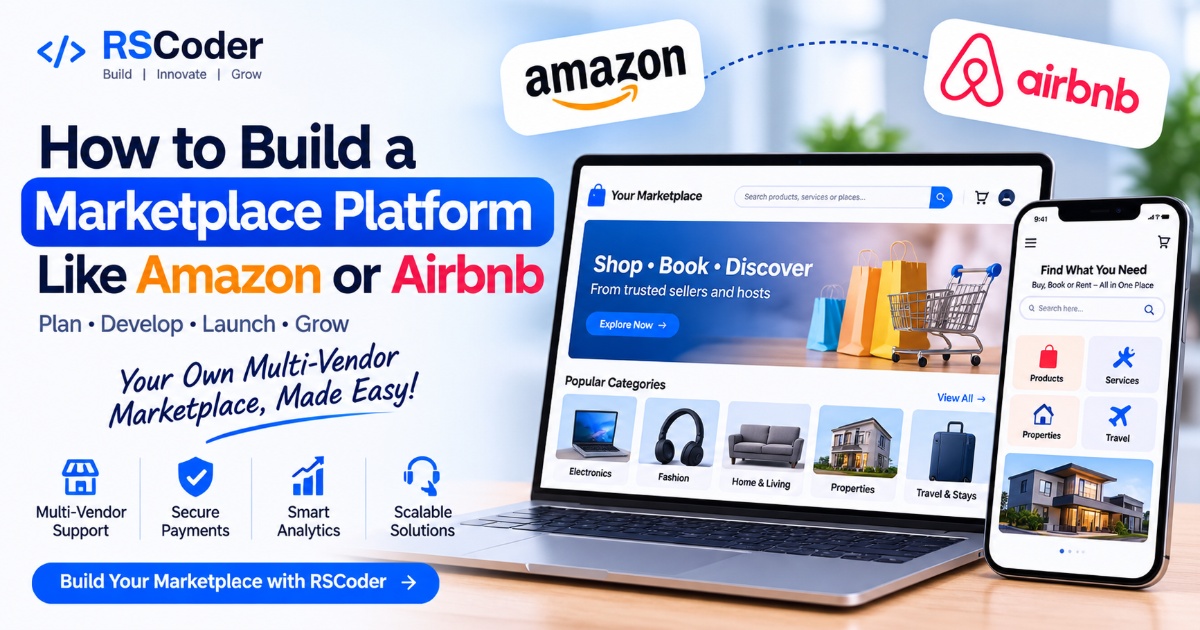
But how do you build a marketplace platform like Amazon or Airbnb? You need more than a website with product listings. A successful marketplace requires user accounts, vendor management, search and discovery, payments, commissions, reviews, security and a strategy for attracting both buyers and sellers.
Planning your own marketplace website or mobile app? RSCoder helps businesses explore custom website development, mobile app development, API integrations and software solutions designed around their business requirements.
Visit rscoder.org to discuss your marketplace development idea.
1. What Is a Marketplace Platform?
A marketplace platform is a digital environment where multiple independent sellers, service providers or property owners connect with customers through a shared website or application.
Unlike a traditional eCommerce store that primarily sells products from one business, a multi-vendor marketplace allows different vendors to manage their own listings and transactions within the platform's rules.
Common marketplace models include:
-
Product marketplaces: Multiple vendors sell physical or digital products.
-
Rental marketplaces: Property owners or other providers offer assets for rent.
-
Service marketplaces: Customers find professionals, freelancers or local service providers.
-
B2B marketplaces: Businesses connect with suppliers, manufacturers and distributors.
-
Local marketplaces: Customers discover businesses and services in specific locations.
-
Booking marketplaces: Users compare availability and reserve services or experiences.
Before investing in development, decide which marketplace model you want to build. An Amazon-style shopping platform needs product catalogues, inventory and order management. An Airbnb-style booking platform needs availability calendars, reservations, host tools and cancellation policies.
The business model should determine the software architecture, not the other way around.
2. Define Your Marketplace Business Model
The first major step in marketplace development is identifying your target audience and how your platform will earn revenue.
Commission-based model
The platform earns a percentage or agreed fee from eligible transactions. This model can work for product marketplaces, service platforms and booking businesses.
Subscription-based model
Vendors pay a recurring fee to access platform features, publish listings or use premium tools.
Listing-fee model
Businesses or individuals pay to publish selected listings, such as properties, vehicles or professional services.
Lead-generation model
Providers pay for qualified enquiries or access to customer leads. This can be useful for service directories and B2B platforms.
Hybrid revenue model
A marketplace can combine commissions, subscriptions, promoted listings and optional premium services. However, the revenue model should remain transparent to users.
Practical recommendation: Validate your niche before building every feature. Speak to potential vendors and customers, identify the problem they want solved, and establish whether they are willing to use or pay for your platform.
3. Essential Features of a Marketplace Platform
A marketplace typically serves three groups: customers, sellers or service providers, and platform administrators. Each needs a suitable interface and permissions.
Customer-side features
The customer experience should make finding, comparing and purchasing products or services straightforward.
Important features include:
-
Registration, login and account management
-
Search, filters and category navigation
-
Product, property or service detail pages
-
Wishlist and saved items
-
Secure checkout or booking
-
Order or reservation tracking
-
Ratings and reviews
-
Notifications and customer support
-
Cancellation, refund or dispute requests where applicable
For an Airbnb-style platform, add date availability, booking requests, guest and host communication, and property-specific policies. For an Amazon-style platform, prioritize inventory availability, shipping options, cart management and order tracking.
Seller or vendor dashboard
Vendors need tools to manage their own business activities without accessing another seller's private information.
Useful features include:
-
Vendor registration and verification
-
Store or service profile management
-
Product and listing management
-
Pricing and inventory controls
-
Order or booking management
-
Commission and earnings reports
-
Payout status
-
Customer communication
-
Performance analytics
Admin dashboard
The administrator oversees the marketplace and maintains its operating rules.
Core functions should include vendor approvals, user management, listing moderation, commission settings, transaction monitoring, refunds, dispute handling, promotional campaigns and business reports.
Plan role-based permissions from the beginning. A vendor should manage their own listings, while administrators control platform-wide settings and oversight.
4. Choose the Right Technology Stack
Your technology stack affects performance, maintainability, integration options and future development.
For a custom marketplace, a possible stack includes:
| Layer | Technology options |
|---|---|
| Website frontend | React, Next.js |
| Mobile application | Flutter, React Native |
| Backend | Node.js, Python, Java |
| Database | PostgreSQL, MySQL |
| Search | OpenSearch, Elasticsearch |
| File and image storage | Cloud object storage |
| Payments | A marketplace-capable payment provider |
| Infrastructure | Suitable cloud hosting and monitoring |
These are options, not a universal prescription. The right stack depends on your marketplace's complexity, team capabilities, expected traffic, budget and integration needs.
A responsive web marketplace may be sufficient for the initial launch. Native or cross-platform mobile applications can follow when user behaviour and business needs justify the investment.
For many startups, a modular architecture is a practical starting point. You can separate major components such as users, listings, orders, bookings, payments and notifications without introducing unnecessary microservices before they are needed.
5. Build Secure Marketplace Payments and Commissions
Payments are one of the most important differences between a regular online store and a multi-vendor marketplace.
A transaction may involve a customer payment, platform commission, vendor earnings, refunds and a later payout. A booking marketplace may also need cancellation fees, deposits or adjustments.
Your payment workflow should account for:
-
Payment collection and confirmation
-
Vendor onboarding and verification
-
Commission calculation
-
Vendor settlement and payouts
-
Refunds and chargebacks
-
Failed transactions and payout retries
-
Transaction records and reconciliation
-
Payment notifications and audit trails
Choose a provider that supports your operating countries, currencies and marketplace business model. In India, evaluate providers such as Razorpay or Cashfree for relevant marketplace and settlement capabilities; international platforms may have different availability and eligibility requirements.
Do not assume that a standard payment gateway automatically supports every marketplace payout workflow. Confirm the provider's capabilities, contractual requirements and compliance obligations before implementation. Never design an informal process that holds or distributes other people's funds without appropriate legal and payment-provider guidance.
6. Add AI Features That Improve the Marketplace Experience
AI can make a marketplace easier to navigate and operate when its features solve specific user problems.
AI-powered search
Help customers find relevant products, properties or services using natural-language queries, synonyms and contextual matching.
Personalized recommendations
Recommend relevant listings based on user preferences, browsing behaviour and permitted interaction data.
Smart listing assistance
Help vendors draft descriptions, organize categories, suggest attributes and improve listing completeness. Human review remains important for accuracy.
AI customer support
Use a chatbot to answer common questions about orders, bookings, platform policies and account navigation. Provide escalation to human support for complex or sensitive cases.
Fraud and risk monitoring
Use appropriate rules and analytical models to flag suspicious activity, unusual transactions or potentially misleading listings for further review.
AI features should be introduced with privacy, transparency, accuracy and human oversight in mind. A useful marketplace does not need every AI feature at launch. Start with the capabilities that improve discovery, trust or operational efficiency.
7. Marketplace SEO: How to Attract Buyers and Sellers
A marketplace needs a discoverability strategy as well as a development strategy. Search traffic can help customers discover individual listings and help vendors find your platform.
Build useful category and listing pages
Create descriptive category pages and unique listing pages with clear titles, helpful content, relevant images and accurate details.
Target specific search intent
A property marketplace could target searches related to rental homes in particular areas. A B2B marketplace might create useful category pages for industrial suppliers or wholesale products.
Avoid generating thousands of near-identical pages that offer little value. Each indexable page should help users make a real decision.
Optimize performance and mobile usability
Improve page loading, image delivery, navigation, accessibility and mobile layouts. Test important user journeys on different screen sizes.
Use structured data where appropriate
Implement relevant structured data for eligible content, such as products or local businesses, when it accurately reflects the visible page. Structured data does not guarantee enhanced search results.
Build trust
Provide clear vendor information, genuine reviews, contact and support options, transparent policies and secure user flows.
SEO works best when it supports a genuinely useful marketplace, not when it is treated as a substitute for product quality.
8. How Much Does Marketplace Development Cost?
The cost of building a marketplace platform depends on its scope rather than simply whether it resembles Amazon or Airbnb.
Key cost factors include:
-
Number and complexity of user roles
-
Website-only versus website and mobile applications
-
Vendor dashboards and admin tools
-
Booking, inventory or order workflows
-
Payment integrations and payout requirements
-
AI features and third-party APIs
-
UI/UX design and accessibility
-
Security, testing and infrastructure
-
Ongoing maintenance and support
A lean MVP can focus on essential listings, search, user accounts and a validated transaction workflow. A more advanced marketplace may need sophisticated booking rules, vendor settlements, logistics integrations, analytics and AI-assisted discovery.
Instead of copying the feature set of a global platform, define the smallest product that can deliver value to a specific audience. Obtain a scoped estimate after requirements and integration needs are documented.
9. Common Marketplace Development Mistakes to Avoid
Many marketplace projects struggle because the business model and operational workflows are overlooked.
Avoid these mistakes:
-
Launching without a clear niche: A focused audience is usually easier to serve than trying to compete with every major marketplace.
-
Building too many features too early: Validate the core transaction before investing in advanced functionality.
-
Ignoring vendor acquisition: Recruit suitable sellers or providers before expecting customers to arrive.
-
Underestimating payment complexity: Plan commissions, refunds, reconciliation and payouts carefully.
-
Neglecting trust and safety: Develop verification, moderation, reporting and dispute processes.
-
Overlooking marketplace SEO: Make useful listings discoverable without publishing low-value duplicate pages.
-
Skipping real-world testing: Test complete customer, vendor and administrator journeys, including failures and refunds.
The marketplace's success depends on supply, demand, trust and reliable operations—not just code.
10. Launch and Scale Your Marketplace Step by Step
A practical development roadmap can follow these stages:
Step 1: Research and validate. Identify a niche, interview potential users and validate the main problem.
Step 2: Define requirements. Document user roles, revenue model, workflows, integrations and success metrics.
Step 3: Design the MVP. Create user journeys and prototypes for the customer experience, vendor dashboard and admin panel.
Step 4: Develop the core platform. Implement accounts, listings, discovery, transactions or bookings, and essential administration.
Step 5: Integrate payments and security. Configure appropriate payment workflows, access controls, data protection and monitoring.
Step 6: Test with real users. Validate usability, performance, transaction accuracy, permissions and error handling.
Step 7: Launch in a focused market. Start with a manageable group of vendors and customers, gather feedback and improve the product.
Step 8: Scale based on evidence. Expand categories, locations, integrations and mobile features when usage data justifies the investment.
Measure more than registrations. Track active vendors, listing quality, search-to-enquiry conversion, completed transactions, repeat usage, cancellations and customer satisfaction.
Build Your Marketplace Platform With RSCoder
Creating a marketplace like Amazon or Airbnb starts with a clear business model and a technology plan that supports real transactions.
RSCoder helps businesses explore custom website and app development, marketplace software, API integrations, AI features and scalable digital solutions. Whether your idea is a multi-vendor eCommerce website, a property rental platform, a B2B marketplace or a service-booking application, the development approach should match your users and operational requirements.
From planning essential features to developing customer interfaces, vendor dashboards and administrative workflows, a well-defined project can help you move from idea to a testable product.
Contact RSCoder to discuss your marketplace website development or marketplace app development requirements.
Frequently Asked Questions
1. How do I build a marketplace platform like Amazon?
Define your niche, validate demand, choose a business model, develop customer and vendor interfaces, implement product listings, search, payments, commissions and administration, then launch and improve based on user feedback.
2. How do I build an app like Airbnb?
You need property or service listings, host and guest accounts, availability calendars, booking management, payments, notifications, reviews, cancellation rules and customer support. The precise requirements depend on your rental model.
3. What is the difference between an eCommerce website and a marketplace?
A conventional eCommerce website often sells products from one business. A multi-vendor marketplace allows multiple independent sellers or service providers to offer products or services through one platform.
4. Can I build a marketplace using custom software?
Yes. Custom marketplace development allows you to define workflows, permissions, integrations, commission rules and features around your business model. Ready-made marketplace platforms may also be suitable when their existing functionality meets your requirements.
5. Which features are essential for a marketplace MVP?
Start with user registration, listings, search, vendor management, a core transaction or booking workflow, suitable payments, basic administration, notifications and trust features. The exact MVP depends on whether the platform sells products, services or bookings.
6. How can a marketplace earn money?
Common revenue models include transaction commissions, vendor subscriptions, listing fees, paid promotions and qualified-lead fees. Choose a model that aligns with your customers, providers and operating costs.
7. Can AI be integrated into a marketplace app?
Yes. AI can support natural-language search, recommendations, listing assistance, customer support and risk monitoring. Start with features that deliver measurable value and use appropriate privacy and oversight controls.
8. Why should I hire a marketplace development company?
An experienced development partner can help define requirements, plan architecture, implement vendor and customer workflows, integrate third-party services, test security and prepare the platform for future growth.
Final Thoughts
Building a marketplace platform like Amazon or Airbnb is a combination of product strategy, software engineering, payment operations, trust and user acquisition. Start with a focused market, build the essential transaction journey, attract quality vendors and improve the experience using real customer feedback.
With a clear roadmap and the right development approach, your marketplace idea can evolve into a useful digital platform for buyers, sellers and service providers.
RSCoder — Explore custom software and marketplace development
Learn how to build a marketplace platform like Amazon or Airbnb, from essential features and technology stack to payment integration, AI capabilities, monetization strategies, and scalable marketplace development with RSCoder.
How to Build a Marketplace Platform Like Amazon or Airbnb