

 Sea Beach
Healthcare technology has already changed how hospitals operate. Hospital Management Systems, Electronic Health Records, laboratory software, pharmacy systems, appointment platforms, billing software, and telemedicine have made healthcare operations faster and more organized.
But the next transformation is much bigger.
The healthcare industry is moving from hospital software to hospital intelligence.
Traditional software mainly stores information and helps employees complete tasks. The next generation of healthcare platforms will increasingly use Artificial Intelligence (AI), automation, predictive analytics, connected data, intelligent workflows, and AI assistants to understand information and help healthcare organizations make better decisions.
Instead of simply asking software to record what happened, hospitals will increasingly use intelligent systems to understand what is happening, what may happen next, and what action should be taken.
This is the beginning of the smart hospital era.
What Is Hospital Intelligence?
Hospital intelligence refers to healthcare technology that goes beyond basic data management and workflow automation.
A traditional hospital system might record:
- Patient appointments
- Medical records
- Laboratory reports
- Pharmacy transactions
- Doctor schedules
- Billing information
- Inventory
- Admissions and discharges
An intelligent hospital platform can use this information to identify patterns, generate insights, automate repetitive processes, and support decision-making.
For example, instead of simply showing that a hospital has fewer available beds, an intelligent system could analyze admission trends, discharge patterns, scheduled surgeries, and historical demand to help hospital administrators anticipate capacity requirements.
The difference is simple:
Traditional Software: Stores and manages information.
Hospital Intelligence: Understands information and helps turn it into action.
Why AI Is Becoming Important in Hospital Technology
Hospitals generate enormous amounts of data every day.
Patient records, diagnostic reports, prescriptions, appointments, insurance information, medical images, inventory data, and operational information all contribute to a complex digital environment.
The challenge isn't simply collecting this data.
The challenge is making useful decisions from it.
AI can help healthcare organizations analyze large volumes of information faster and identify patterns that may be difficult to discover manually.
This creates opportunities across clinical, administrative, financial, and operational workflows.
AI can potentially assist with:
- Patient scheduling
- Medical documentation
- Workflow automation
- Patient communication
- Resource planning
- Predictive analytics
- Inventory management
- Report summarization
- Healthcare analytics
- Administrative support
The goal isn't to replace healthcare professionals.
The goal is to give them better digital tools.
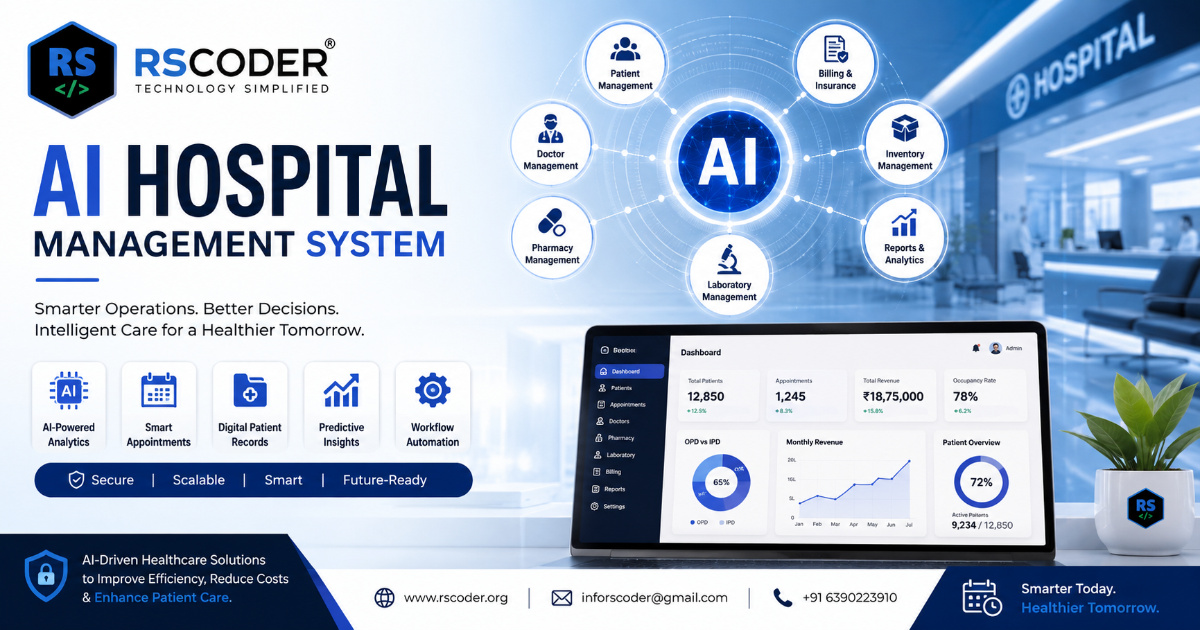
The AI-Powered Hospital Management System
Hospital Management Systems have traditionally been the backbone of hospital operations.
But future HMS platforms can become much more intelligent.
Imagine a hospital dashboard that doesn't simply display numbers but actively highlights important changes.
For example:
Patient admissions increasing by 18% this week.
Emergency department demand expected to increase tomorrow.
Pharmacy inventory for a frequently used medicine is approaching its reorder level.
Several appointments require follow-up.
Laboratory workload is significantly higher than the weekly average.
Instead of employees searching through multiple reports, AI can bring important information directly to their attention.
This can make hospital management more proactive rather than reactive.
AI-Powered Patient Management
Patient experience is another area where hospital intelligence can make a significant difference.
A modern healthcare platform could connect appointments, patient communication, medical records, follow-ups, and notifications into one intelligent workflow.
For example:
A patient books an appointment.
The system identifies the department and doctor.
AI checks availability and schedules the appointment.
The patient receives an automated confirmation.
Before the appointment, the system sends a reminder.
After the consultation, the platform can trigger appropriate follow-up communication.
If a follow-up appointment is required, the system can automatically remind the patient.
This creates a smoother patient journey while reducing repetitive administrative work.
AI in Medical Records and Healthcare Data
Healthcare organizations often have information distributed across different systems.
Patient information may exist in hospital software, laboratory platforms, pharmacy systems, diagnostic systems, and other applications.
This fragmentation can make healthcare operations more complicated.
The future of healthcare technology will increasingly depend on connected and interoperable systems.
AI can become an intelligence layer across these systems, helping organizations extract useful insights from connected information.
For example, an intelligent platform could combine:
Patient Data + Laboratory Data + Pharmacy Data + Appointment Data + Operational Data
and transform these inputs into actionable insights.
This is where healthcare APIs and integrations become increasingly important.
AI-Powered Laboratory Management
Laboratories are another major opportunity for intelligent automation.
A modern Laboratory Management System can already manage sample registration, test processing, reports, billing, and patient information.
AI can add another layer.
An intelligent laboratory platform could help identify unusual patterns, prioritize workflows, summarize reports, and provide operational analytics.
For example, laboratory managers could use AI-powered dashboards to understand:
- Test volume trends
- Processing delays
- Resource utilization
- Frequently requested tests
- Inventory requirements
- Operational bottlenecks
The objective is not to allow AI to independently make clinical decisions.
Instead, AI can support healthcare professionals by organizing information and highlighting relevant patterns.
Smarter Pharmacy Management
Pharmacy operations involve inventory, prescriptions, billing, suppliers, and medication availability.
AI-powered pharmacy software can potentially make these workflows more efficient.
An intelligent system could analyze historical usage and help predict inventory requirements.
Instead of discovering that an important medicine is unavailable after demand increases, hospital administrators could receive an early warning.
AI can also help automate repetitive processes such as:
- Inventory monitoring
- Reorder alerts
- Stock analysis
- Expiry tracking
- Prescription workflows
- Pharmacy reporting
This can reduce manual effort and improve operational visibility.
AI and Online Doctor Consultation
Telemedicine has already expanded access to healthcare.
The next generation of online consultation platforms can become more intelligent through AI.
Patients may interact with an AI-powered assistant before speaking with a doctor.
The assistant could collect basic information, understand the reason for the consultation, organize patient-provided details, and prepare a structured summary for the healthcare professional.
The doctor can then spend less time collecting repetitive information and more time focusing on the consultation.
However, healthcare AI must be designed carefully.
AI should support qualified healthcare professionals rather than blindly replacing clinical judgment.
Predictive Healthcare: Moving From Reaction to Prevention
One of the most powerful possibilities of AI is predictive analytics.
Traditional healthcare systems often respond after something happens.
Intelligent healthcare systems can increasingly look for patterns that may indicate what could happen next.
For hospitals, predictive analytics could support areas such as:
- Patient demand forecasting
- Bed utilization
- Appointment demand
- Resource planning
- Inventory requirements
- Operational bottlenecks
This doesn't mean AI can predict every medical event.
Instead, it means healthcare organizations can use historical and real-time data to make more informed operational decisions.
The long-term vision is powerful:
From reacting to problems → to identifying risks earlier.
The Rise of AI Healthcare Assistants
Another emerging concept is the healthcare AI assistant.
Instead of navigating multiple dashboards, doctors, nurses, administrators, or patients could interact with an intelligent assistant.
A hospital administrator might ask:
"Show me today's department performance."
A doctor might ask:
"Summarize the patient's recent reports available in the system."
A pharmacy manager might ask:
"Which medicines require attention based on current inventory?"
A patient might ask:
"When is my next appointment?"
The AI assistant becomes a natural-language interface between people and healthcare software.
This can make complex systems easier to use.
Smart Hospitals Will Be Connected Ecosystems
The smart hospital of the future won't depend on one application.
It will be an ecosystem.
Hospital Management
↓
Patient Management
↓
Laboratory
↓
Pharmacy
↓
Doctor Consultation
↓
Billing
↓
Analytics
↓
AI Intelligence Layer
When these systems communicate effectively, hospitals can gain a much more complete understanding of their operations.
AI can then work across this connected environment to automate workflows and generate useful insights.
Healthcare AI Needs Security and Responsibility
The opportunity is enormous, but healthcare is not an industry where technology should be deployed without strong safeguards.
Healthcare systems handle highly sensitive information.
Modern healthcare software therefore needs strong attention to:
- Data security
- Privacy
- Access control
- Encryption
- Audit trails
- Secure APIs
- Role-based permissions
- Responsible AI
- Human oversight
AI should be transparent about its limitations.
Healthcare professionals should remain involved in decisions where clinical expertise is required.
The most successful healthcare AI systems will not simply be the most advanced.
They will be the ones that combine intelligence, security, reliability, usability, and responsible implementation.
How RS Coder Can Help Build Intelligent Healthcare Solutions
Moving from traditional healthcare software to an intelligent healthcare ecosystem requires more than simply adding an AI chatbot.
It requires the right combination of software development, APIs, databases, automation, user experience, security, and AI integration.
At RS Coder, healthcare organizations can build custom digital solutions around their specific workflows, including:
- AI-powered Hospital Management Systems
- Patient Management Software
- Pharmacy Management Systems
- Laboratory Management Systems
- Pathology Management Solutions
- Blood Bank Management Systems
- Online Doctor Consultation Platforms
- Healthcare Mobile Applications
- Healthcare API Integration
- Custom Healthcare Automation
- AI-powered healthcare analytics
The advantage of a custom approach is that the technology can be designed around the organization's actual processes instead of forcing the organization to completely change its workflow around generic software.
The Future: Hospital Intelligence as a Digital Foundation
The biggest change in healthcare technology isn't going to be one single AI feature.
It will be the gradual transformation of hospital software into an intelligent digital foundation.
Today's system may tell hospital administrators:
"Here is your data."
Tomorrow's system may increasingly say:
"Here is what is happening, here is what needs attention, and here is what you can do next."
That shift can change how hospitals manage resources, communicate with patients, coordinate departments, and analyze operations.
The future hospital will not simply be digital.
It will be connected, intelligent, predictive, automated, and human-centered.
Final Thoughts
The healthcare industry is moving toward a new technology model.
Hospital Management Systems, laboratory platforms, pharmacy software, patient applications, telemedicine, and healthcare analytics are becoming interconnected—and AI can become the intelligence layer that brings these systems together.
The goal isn't to replace doctors, nurses, administrators, or healthcare professionals.
The goal is to give them better information, reduce repetitive work, improve workflows, and create more connected patient experiences.
The transition from hospital software to hospital intelligence is already becoming one of the most important opportunities in healthcare technology.
For hospitals, clinics, diagnostic centers, pharmacies, and healthcare businesses, the question is no longer simply:
"Do we need healthcare software?"
The better question is:
"How intelligent can our healthcare technology become?"
And that is where the next generation of healthcare innovation begins.
Ready to build an AI-powered healthcare platform?
RS Coder can help transform your healthcare workflow into a modern, secure, scalable digital solution.
🌐 rscoder.org
📩 inforscoder@gmail.com
📞 +91 6390223910
Discover how AI is transforming hospital software into intelligent healthcare systems with smart automation, predictive analytics, connected data, and personalized patient experiences.
From Hospital Software to Hospital Intelligence: How AI Is Building the Next Generation of Smart Healthcare