


 Sea Beach
The Next Big App Could Start With One Local Problem
Imagine opening an app to book a ride, order dinner, get groceries delivered or arrange a local service within minutes. Platforms such as Uber, Zomato and Swiggy have made this convenience part of everyday life.
For entrepreneurs and established businesses, these platforms provide an important lesson: a successful app is not simply a collection of screens. It connects customers, service providers, payments, logistics and real-time information through one reliable digital system.
In 2026, businesses can go further by incorporating artificial intelligence (AI), predictive analytics, personalized recommendations and intelligent automation into their applications.
Want to turn your app idea into a scalable digital product? RSCoder provides website development, mobile app development and custom software solutions to help businesses plan and build technology around their goals.
1. Decide What Type of App You Want to Build
Before starting development, define the problem your application will solve and identify its primary audience.
App like Uber
A ride-booking platform connects passengers with available drivers. Its main requirements include location tracking, driver matching, fare calculation, route navigation and trip management.
App like Zomato
A restaurant discovery and food-ordering platform helps customers find restaurants, explore menus, place orders and track deliveries. Restaurant management and delivery coordination are central to its operation.
App like Swiggy
A food delivery platform combines customer ordering, restaurant operations and delivery partner management. Businesses can later explore additional services, such as grocery delivery, subject to operational feasibility.
A specialized on-demand app
You do not need to compete with major platforms across every category. You could build a local taxi-booking app, a restaurant delivery platform for a particular city, a medicine delivery solution or a home-service booking app.
Start with a specific customer problem, geographic area or underserved market. A focused product can be easier to validate than a broad platform that attempts to serve everyone from day one.
2. Essential Features Your App Needs
An on-demand application usually requires several connected interfaces working with a shared backend.
| Component | Essential features |
|---|---|
| Customer app | Registration, search, booking, payments, live tracking, order history and ratings |
| Driver or delivery partner app | Availability, job requests, navigation, status updates and earnings |
| Restaurant or service-provider panel | Profile management, orders, availability, menus or service listings |
| Admin dashboard | User management, commissions, disputes, analytics, payouts and reports |
| Shared backend | APIs, databases, notifications, security and real-time updates |
The exact structure depends on the business model. A ride-booking app needs passenger and driver workflows, while a food delivery platform also needs restaurant order management.
Features to prioritize in the first version
Start with registration, service discovery, booking or ordering, payment integration, status updates, notifications and an administrative dashboard.
For an Indian audience, consider suitable payment methods such as UPI, cards and cash where appropriate. Include clear cancellation policies, transparent charges and accessible customer support.
Avoid adding dozens of advanced features before confirming that customers can complete the main task smoothly.
3. AI-Powered Features That Can Make Your App Stand Out
AI can help an on-demand platform become more relevant, efficient and responsive. However, AI should solve a measurable problem rather than exist only as a marketing label.
Personalized recommendations
A food delivery app can suggest restaurants, cuisines or dishes based on a customer's preferences, previous orders, current context and available options. A ride-booking app might highlight frequently used destinations or suitable ride categories.
Recommendations should remain transparent and allow users to change their preferences.
Intelligent matching and dispatch
For ride-booking and delivery platforms, matching systems can consider distance, availability, estimated arrival time, capacity and current workload. AI or machine-learning models may improve these decisions when sufficient reliable data is available.
The goal is not simply to select the nearest driver. It is to make a suitable match while balancing customer experience, operational efficiency and provider fairness.
Predictive delivery and arrival estimates
Historical trip data, current traffic conditions, restaurant preparation times and live operational signals can help improve estimated arrival times.
The application should update estimates when conditions change instead of displaying misleadingly precise promises.
AI customer support
An AI support assistant can answer common questions about order status, booking policies, refunds and account issues. It can also route complicated or sensitive cases to human support.
Payment disputes, safety incidents and exceptional refund decisions should have appropriate human oversight.
Demand forecasting
AI models can help forecast busy periods, identify areas with rising demand and estimate inventory needs. Businesses may use these insights to plan staffing, delivery capacity or restaurant preparation.
Fraud detection and trust
Automated systems can flag suspicious transactions, unusual booking patterns or potential account abuse for further review. Decisions that affect customers or delivery partners should include safeguards against false positives.
For a new app, begin with useful analytics and simple rules-based automation. Introduce personalized machine-learning models when sufficient quality data has accumulated. Advanced features cannot deliver reliable results if the underlying data is incomplete.
4. How to Build an App Like Uber, Zomato or Swiggy: Step by Step
Step 1: Research the market
Identify your target audience, competitors, service area, pricing model and customer pain points. Interview potential users and local service providers before committing to a large development budget.
Step 2: Define your business model
Decide how the platform will earn revenue. Options include commissions, delivery charges, booking fees, subscriptions, sponsored listings or business partnerships.
Test whether the model can support customer acquisition, provider payments, support costs and ongoing operations.
Step 3: Design the user experience
Create wireframes and clickable prototypes for the customer app, provider interface and admin dashboard. Test the booking process, payment flow and cancellation experience with representative users.
Prioritize fast navigation, accessible design and clear information.
Step 4: Choose the technology stack
A practical technology stack may include:
-
Mobile app: Flutter or React Native for cross-platform development, or native development when specific platform requirements justify it.
-
Backend: Node.js, Python or another suitable server-side framework.
-
Database: PostgreSQL or another database selected for the application's data model.
-
Real-time updates: WebSockets or managed real-time services.
-
Maps and navigation: A suitable mapping provider with location and routing APIs.
-
Payments: A payment gateway that supports the intended market and business model.
-
Cloud infrastructure: A scalable cloud platform with monitoring, backups and security controls.
The best stack depends on team expertise, integrations, expected traffic and long-term maintenance requirements. A new business rarely needs an unnecessarily complicated microservices architecture at launch.
Step 5: Build the backend and integrations
Develop user authentication, booking workflows, order status management, payment processing, notifications and provider assignment. Establish a consistent record of each booking or order so every interface displays the same status.
Payment webhooks, retries, duplicate-request protection and audit logs are particularly important for financial reliability.
Step 6: Test before launch
Test real devices, slow networks, failed payments, location errors, cancellations, simultaneous bookings and unexpected application shutdowns.
For ride-booking platforms, test driver assignment and safety workflows. For food delivery, test menu availability, restaurant acceptance, preparation status and delivery completion.
Step 7: Launch in a focused market
Start with a manageable service area and a controlled group of providers. Monitor completed bookings, repeat usage, cancellations, delivery times, customer complaints and contribution margins.
Expand when the service is dependable and the business model shows signs of working.
Build your platform with the right foundation. Contact RSCoder to discuss custom mobile app development, backend systems, AI integrations and the features that matter most for your business.
5. How Much Does It Cost to Build an App Like Uber, Zomato or Swiggy?
There is no universal development price because the scope can range from a basic booking MVP to a multi-city marketplace with advanced automation.
The main cost factors include:
-
Number of mobile applications and dashboards.
-
Complexity of booking, dispatch and order management.
-
Map usage, real-time tracking and third-party APIs.
-
Payment integrations, commissions and provider payouts.
-
AI model development, data infrastructure and monitoring.
-
Security, quality assurance, maintenance and ongoing support.
A focused MVP typically requires less investment than a mature platform supporting multiple cities, complex logistics and high transaction volumes. AI features can also introduce additional data, testing and infrastructure requirements.
Request a scope-based estimate that separates initial development, third-party charges, cloud hosting, maintenance and future enhancements. This makes it easier to compare proposals fairly.
6. New Opportunities: Build More Than a Copy
Instead of copying every feature from a major platform, consider developing a differentiated product.
Potential directions include:
-
Hyperlocal delivery: Serve a particular city, neighborhood or underserved category.
-
AI-assisted discovery: Help users find relevant restaurants or services through natural-language search.
-
Business-specific platforms: Build booking and delivery systems for pharmacies, specialty retailers or local service providers.
-
Smarter operations: Use forecasting, automated notifications and workload planning to reduce avoidable delays.
-
Accessibility-first experiences: Support clear navigation, multiple languages and inclusive user journeys.
-
Sustainability features: Explore efficient route planning, delivery batching and suitable low-emission options.
For AI-powered discovery, users might type, “Find vegetarian dinner options under my budget that can arrive soon.” The system can interpret the request and filter real menu data, availability, location and delivery estimates.
This approach requires accurate live data, clear ranking criteria and safeguards against invented or unavailable results.
7. Security, Privacy and Reliability Must Come First
On-demand apps may process addresses, live locations, contact information, payment records and personal preferences. Protecting this information is essential.
Use secure authentication, least-privilege access, encrypted connections, appropriate data retention and secure payment integrations. Request location permissions only when needed and explain why location data is collected.
Provide clear processes for account deletion, complaints, refunds and safety incidents. Review applicable privacy, consumer protection, payment and sector-specific requirements in the markets where the app will operate.
AI systems also require monitoring for inaccurate recommendations, biased outcomes, privacy risks and unintended behavior.
A successful platform must earn customer trust repeatedly, not just deliver a convenient first experience.
8. Why Choose RSCoder for App Development?
Building an on-demand platform requires more than an attractive mobile interface. It needs a dependable backend, connected user journeys, secure integrations and a development roadmap that supports future growth.
RSCoder provides website and mobile app development, custom software solutions and digital marketing services. A project can be planned around its core business requirements, with AI capabilities introduced where they offer practical value.
Explore RSCoder's website to discuss an app concept, its essential features and a suitable development approach.
Frequently Asked Questions
1. How long does it take to build an app like Uber or Zomato?
The timeline depends on features, team size, integrations and testing requirements. A focused MVP may take several months, while a more complex multi-sided platform can require substantially longer.
2. Can I build an app like Swiggy for one city?
Yes. A single-city launch can help you validate customer demand, recruit local restaurants and delivery partners, and improve operations before expanding.
3. Which technology is best for an on-demand app?
Flutter and React Native are common cross-platform choices. Backend frameworks, databases, mapping services and cloud infrastructure should be selected according to the product's requirements and the development team's expertise.
4. Can AI be integrated into a delivery or ride-booking app?
Yes. Potential applications include recommendations, customer support, demand forecasting, arrival-time estimation, fraud detection and dispatch optimization. Each feature should be tested against measurable business outcomes.
5. Should I build every feature before launching?
No. Start with the essential booking or ordering journey, reliable payments, provider workflows and administration. Add advanced capabilities based on customer feedback and real usage data.
6. How can an Uber-like or food delivery app earn money?
Possible revenue streams include commissions, booking or delivery fees, subscriptions, sponsored listings and business partnerships. The right combination depends on customer expectations, provider economics and local competition.
Conclusion
Building an app like Uber, Zomato or Swiggy in 2026 means creating a complete digital marketplace—not just a mobile application. Success depends on solving a genuine customer problem, building reliable booking and delivery workflows, protecting user data and establishing a sustainable business model.
AI can make the platform more personalized and efficient, but the strongest starting point is a well-designed core product with accurate data and dependable operations.
Ready to build your on-demand app?
Partner with RSCoder to explore mobile app development, custom software and practical AI integrations for your business.
Plan smart. Build reliably. Scale with purpose.
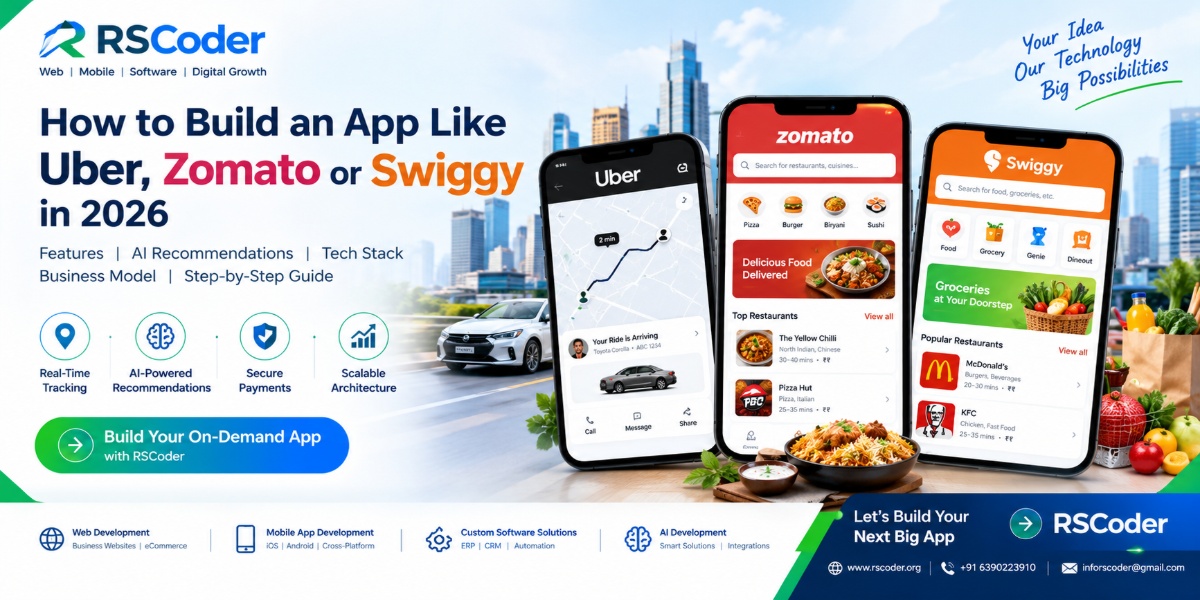
Want to build an app like Uber, Zomato or Swiggy? Explore the essential features, AI-powered recommendations, technology stack, business models and development strategies for creating a scalable on-demand application in 2026.
How to Build an App Like Uber, Zomato or Swiggy ?