

 Sea Beach
Generative AI vs Agentic AI | Business AI Solutions | AI Software Development | RSCoder
Artificial intelligence is rapidly moving from experimentation to real business use. In 2026, companies are no longer asking only whether they should use AI—they are asking which type of AI will deliver the best business value: Generative AI or Agentic AI?
Generative AI has already transformed how businesses create content, analyze information, generate code, summarize documents, support customers, and interact with data. Agentic AI takes the concept further by enabling AI systems to understand goals, plan multiple steps, use tools, and perform actions with varying levels of human supervision. Google Cloud describes 2026 as a period in which AI agents are increasingly reshaping productivity and complex workflows.
For businesses, however, the answer is not simply "Agentic AI is better." The right investment depends on your business problem, data, workflows, budget, security requirements, and desired level of automation.
This guide explains the difference between Generative AI and Agentic AI and helps businesses understand where each technology fits.
What Is Generative AI?
Generative AI is artificial intelligence designed to create new content based on patterns learned from large amounts of data.
It can generate:
- Text
- Images
- Code
- Audio
- Video
- Reports
- Product descriptions
- Marketing content
- Summaries
- Business recommendations
For example, a company could use Generative AI to create a product description from a few specifications.
A customer-support team could use it to draft responses to common customer questions.
A software development team could use it to generate code, explain existing code, create documentation, or assist with testing.
The key characteristic is that Generative AI primarily creates or transforms information in response to instructions.
What Is Agentic AI?
Agentic AI refers to AI systems designed to work toward a goal by planning tasks, using tools, accessing information, and taking actions.
Instead of simply answering:
"What should I do?"
an agentic system can potentially work through:
Understand → Plan → Execute → Check → Adapt → Complete
For example, imagine a company wants to automate lead management.
A Generative AI system could write a follow-up email.
An Agentic AI system could:
- Identify new leads.
- Analyze their requirements.
- Check CRM information.
- Prioritize leads.
- Draft a personalized response.
- Send the response according to business rules.
- Schedule a follow-up.
- Update the CRM.
- Notify a salesperson when human intervention is needed.
That difference—content generation versus goal-oriented action—is one of the most important distinctions between the two technologies.
OpenAI describes agentic AI as moving knowledge work from individual interactions toward delegated, longer-running tasks involving tool use and iteration.
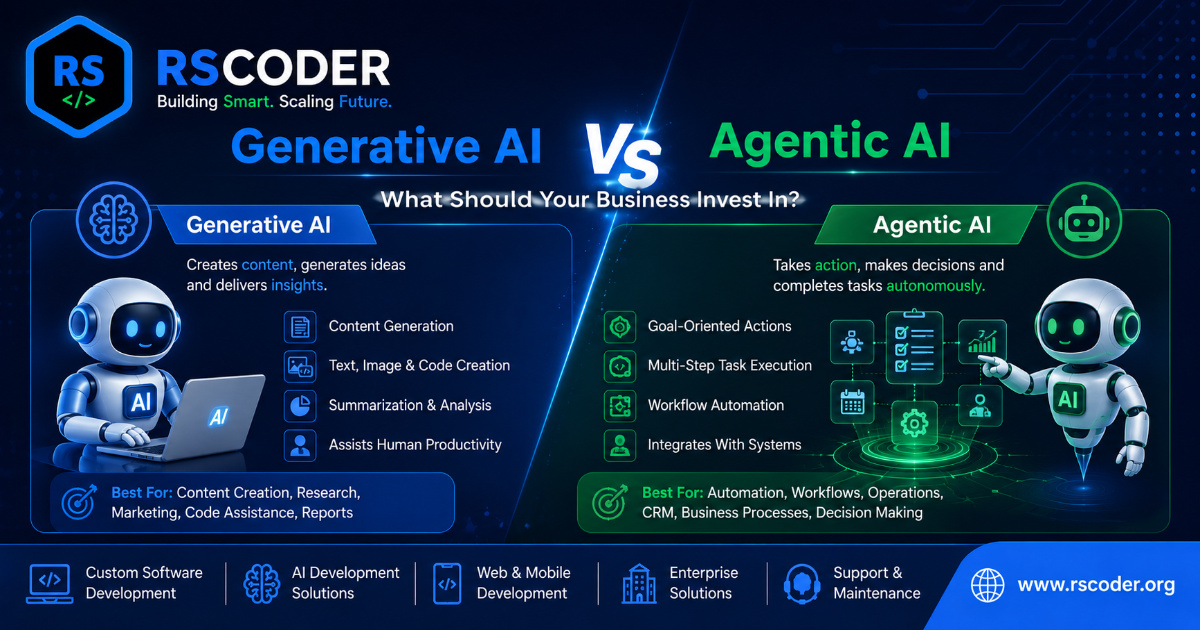
Generative AI vs Agentic AI: Key Difference
| Feature | Generative AI | Agentic AI |
|---|---|---|
| Primary purpose | Generate content and insights | Achieve goals and complete tasks |
| Interaction | Usually prompt-driven | Goal/workflow-driven |
| Autonomy | Generally lower | Generally higher |
| Planning | Limited | Multi-step planning |
| Tool usage | May be connected to tools | Designed to use tools and systems |
| Decision-making | Provides suggestions | Can execute decisions within defined limits |
| Workflow automation | Moderate | High |
| Best for | Content, analysis, assistance | Complex workflows and automation |
| Human involvement | Usually high | Can be reduced for suitable tasks |
| Business complexity | Simple to moderate | Moderate to highly complex |
Neither technology is universally better.
The better choice depends on what your organization needs to accomplish.
Why Generative AI Is Still Important in 2026
The rise of Agentic AI does not mean Generative AI is becoming obsolete.
In fact, Generative AI remains one of the foundations of modern AI applications.
Businesses can use it for:
Content Creation
Marketing teams can generate:
- Blog content
- Social media posts
- Product descriptions
- Advertisements
- Email drafts
Customer Support
Generative AI can help customer-service teams produce faster and more relevant responses.
Software Development
Developers can use AI for:
- Code generation
- Debugging assistance
- Documentation
- Test generation
- Code explanation
Document Processing
Businesses can summarize long documents, extract information, classify text, and create structured outputs.
Data Analysis
AI can help employees interact with business data using natural language and generate understandable summaries.
For many businesses, these applications can provide significant value without requiring a fully autonomous agent.
Why Agentic AI Is Becoming a Major Business Trend
Agentic AI is gaining attention because businesses increasingly want AI to do work, rather than simply generate answers.
The 2026 Agentic Enterprise Report from Contentstack found that 89% of surveyed enterprise leaders considered agentic AI a strategic priority, while 58% reported having agentic AI programs running in production. The same research highlighted data readiness, integration, governance, and security as important challenges.
Agentic AI can be particularly valuable when a business has repetitive processes that involve several systems.
For example:
Customer enquiry → CRM → Product database → Pricing → Email → Follow-up → Sales notification
Instead of employees manually moving information between systems, an agent can potentially coordinate parts of the workflow.
This is where Agentic AI can create a major difference.
Generative AI or Agentic AI: Which Should Your Business Choose?
There is no universal answer.
Choose Generative AI if you need:
- AI content creation
- AI chatbots
- Document summarization
- Text analysis
- Code assistance
- Image generation
- AI-powered search
- Employee productivity tools
- Customer-response assistance
If your goal is to help people work faster, Generative AI may be the best starting point.
Choose Agentic AI if you need:
- Workflow automation
- Multi-step task execution
- AI-powered business processes
- Automated CRM operations
- Automated customer workflows
- Cross-system automation
- AI-powered decision support
- Intelligent task delegation
If your goal is to automate a process, Agentic AI may be the better fit.
The Best Strategy May Be Generative AI + Agentic AI
Businesses should not necessarily treat these technologies as competitors.
In many modern applications, they work together.
Consider an AI-powered sales platform.
An Agentic AI layer could determine:
"This lead requires immediate follow-up."
A Generative AI layer could then create:
"A personalized email based on the customer's requirements and previous interactions."
The agent could then use the CRM API to update the record and schedule the next action.
In this architecture:
Generative AI = Creates and understands
Agentic AI = Plans and acts
Together, they can create more powerful business software.
Examples of Generative AI vs Agentic AI in Business
1. E-Commerce
Generative AI:
- Product descriptions
- Marketing content
- Customer responses
- Product recommendations
Agentic AI:
- Monitor orders
- Identify delayed shipments
- Contact customers
- Update support tickets
- Escalate important issues
2. Healthcare
Generative AI:
- Summarize documents
- Generate administrative drafts
- Assist communication
- Answer information queries
Agentic AI:
- Coordinate appointment workflows
- Route administrative requests
- Manage follow-up processes
- Trigger appropriate notifications
Healthcare implementations require strong privacy, security, and human oversight.
3. Real Estate
Generative AI:
- Property descriptions
- Marketing messages
- Customer responses
- Listing summaries
Agentic AI:
- Qualify leads
- Match requirements with properties
- Schedule follow-ups
- Update CRM records
- Notify sales teams
4. Education
Generative AI:
- Learning materials
- Quiz generation
- Explanations
- Personalized content
Agentic AI:
- Track learning workflows
- Identify students requiring attention
- Trigger reminders
- Coordinate administrative processes
5. Finance and Business Operations
Generative AI:
- Report summaries
- Document analysis
- Business insights
- Draft communications
Agentic AI:
- Coordinate approval workflows
- Collect information
- Route tasks
- Monitor defined processes
- Escalate exceptions
Sensitive financial operations should use strict access controls and human approval where appropriate.
What Should Businesses Invest In First?
For most businesses, the smartest approach is not to immediately build a fully autonomous AI system.
Instead, start with a specific business problem.
Step 1: Identify the Problem
Ask:
- Which process consumes the most employee time?
- Which tasks are repetitive?
- Where are delays occurring?
- Which activities require employees to use multiple systems?
- Which customer interactions could be improved?
Step 2: Determine the AI Type
If you need content or analysis:
Start with Generative AI.
If you need multi-step automation:
Consider Agentic AI.
If you need both:
Build a combined AI architecture.
Step 3: Start With One High-Value Workflow
Instead of automating everything, select one measurable workflow.
For example:
Lead qualification
Then measure:
- Response time
- Conversion rate
- Employee hours saved
- Cost per lead
- Customer satisfaction
Step 4: Build for Scale
Once the first workflow demonstrates value, additional AI capabilities can be introduced.
AI Investment Should Focus on ROI, Not Hype
One of the biggest mistakes businesses can make in 2026 is investing in AI simply because competitors are doing it.
The better question is:
"What measurable business outcome will this AI solution improve?"
Possible KPIs include:
- Reduce manual work by 30%
- Improve customer response time
- Increase lead conversion
- Reduce operational errors
- Accelerate document processing
- Improve employee productivity
- Reduce support workload
KPMG's 2026 AI Pulse research highlights that organizations are increasingly focused on the economics of AI at scale, including cost visibility, monitoring, approvals, and governance.
AI investment should therefore be evaluated through both business value and operational cost.
Data Is the Foundation of Agentic AI
Businesses sometimes focus heavily on the AI model and overlook the data underneath it.
That can create problems.
An AI agent needs access to reliable information to perform useful work.
Important foundations include:
- Clean business data
- Structured databases
- Secure APIs
- Reliable integrations
- Document management
- Access controls
- Data governance
- Monitoring
Contentstack's 2026 research found that data and content readiness was a significant challenge for enterprises deploying agentic AI, with many organizations reporting that they wished they had invested earlier in their underlying data infrastructure.
This means an AI project may require more than simply connecting an AI model.
It may require modernizing the software ecosystem around it.
Security and Governance Matter More With Agentic AI
The more actions an AI system can perform, the more important governance becomes.
A business should define:
- What the AI can access
- What actions it can perform
- Which actions require approval
- What data it can use
- How activities are logged
- How errors are handled
- How the system is monitored
Deloitte's 2026 AI research similarly highlights a gap between growing agentic AI adoption and mature governance for autonomous systems.
The objective should be:
Controlled automation—not uncontrolled autonomy.
How RSCoder Can Help Businesses Adopt AI
At RSCoder, businesses can approach AI as part of a broader software strategy rather than treating it as an isolated feature.
A custom AI solution can be designed around your:
- Business workflows
- Existing software
- CRM and ERP systems
- Databases
- APIs
- Web applications
- Mobile applications
- Customer-support systems
- Internal operations
Whether your business needs a Generative AI application, AI chatbot, AI-powered automation, Agentic AI workflow, or custom software solution, the right architecture should begin with the business requirement.
RSCoder can help businesses move from an AI idea to a practical digital solution designed around their processes and goals.
The Future: From AI Tools to AI-Powered Businesses
The next stage of business AI is not simply about having access to a chatbot.
It is about integrating intelligence directly into business operations.
We are moving toward:
Traditional Software → AI-Assisted Software → AI-Powered Workflows → Agentic Enterprise
Generative AI will continue to help businesses create, understand, summarize, and communicate.
Agentic AI will increasingly help businesses coordinate tasks, interact with systems, and automate workflows.
And the strongest business applications may combine both.
Current enterprise research shows that organizations are moving toward broader AI adoption, but successful scaling depends heavily on infrastructure, data, governance, skills, and measurable business value.
Final Verdict: Generative AI vs Agentic AI
So, what should your business invest in?
The answer depends on your objective.
Invest in Generative AI when you want to:
- Create content
- Analyze information
- Improve employee productivity
- Build AI assistants
- Generate code
- Improve customer interactions
Invest in Agentic AI when you want to:
- Automate workflows
- Execute multi-step tasks
- Connect business systems
- Reduce repetitive operations
- Build intelligent business processes
Invest in both when you want to build a comprehensive AI-powered business platform.
For many organizations, the most practical path is to start with a clearly defined Generative AI use case, measure its value, and then introduce agentic capabilities where automation can deliver additional ROI.
The future isn't necessarily Generative AI vs Agentic AI.
It is Generative AI + Agentic AI + Custom Software + Business Data working together.
With the right strategy, RSCoder can help businesses turn these technologies into practical, scalable, and business-focused digital solutions.
Frequently Asked Questions
1. What is the difference between Generative AI and Agentic AI?
Generative AI primarily creates content, answers questions, and analyzes information. Agentic AI is designed to pursue goals, plan multiple steps, use tools, and perform actions within defined permissions.
2. Is Agentic AI better than Generative AI?
Not necessarily. Generative AI is better for content creation, analysis, and assistance, while Agentic AI is better suited to complex workflows and task automation. The right choice depends on the business requirement.
3. Which AI should my business invest in?
Businesses should choose based on the desired outcome. If you need productivity and content generation, Generative AI may be the right starting point. If you need workflow automation, Agentic AI may provide greater value.
4. Can Generative AI and Agentic AI work together?
Yes. Generative AI can generate and interpret information while Agentic AI can coordinate workflows and take actions. Combining both can create powerful AI-powered business applications.
5. What are some examples of Generative AI for businesses?
Common examples include AI chatbots, content generation, document summarization, code generation, marketing automation, customer-support assistance, and business report generation.
6. What are some examples of Agentic AI for businesses?
Examples include automated lead qualification, CRM workflow automation, customer-service processes, inventory workflows, appointment coordination, document workflows, and multi-system business automation.
7. Is Agentic AI expensive to develop?
The cost depends on the complexity of the workflow, AI models, integrations, data architecture, security, interfaces, and level of automation. A focused workflow is generally less complex than a large multi-agent enterprise platform.
8. Is Agentic AI safe for business use?
Agentic AI can be used safely when appropriate security, permissions, monitoring, logging, governance, and human approval mechanisms are implemented.
9. Does my business need custom AI development?
Custom AI development can be valuable when you need AI connected to proprietary data, internal workflows, CRM/ERP systems, APIs, or specialized business requirements that generic AI tools cannot adequately address.
10. Can RSCoder develop Generative AI solutions?
Yes. RSCoder can develop custom AI-powered software solutions around specific business requirements, including AI applications, automation, intelligent workflows, and integrations.
11. Can RSCoder develop Agentic AI solutions?
RSCoder can help businesses plan and develop AI-powered workflow solutions designed around their processes, integrations, data, and automation requirements.
12. How should a business start an AI project?
Start by identifying one high-value business problem, defining the desired outcome, evaluating available data and integrations, selecting the appropriate AI approach, and establishing measurable KPIs.
Generative AI vs Agentic AI—discover the key differences, business use cases, benefits, and investment opportunities in 2026. Learn how RSCoder helps businesses build smarter AI-powered software, automation, and intelligent workflows.
Generative AI vs Agentic AI: What Should Your Business Invest In?