

 Sea Beach
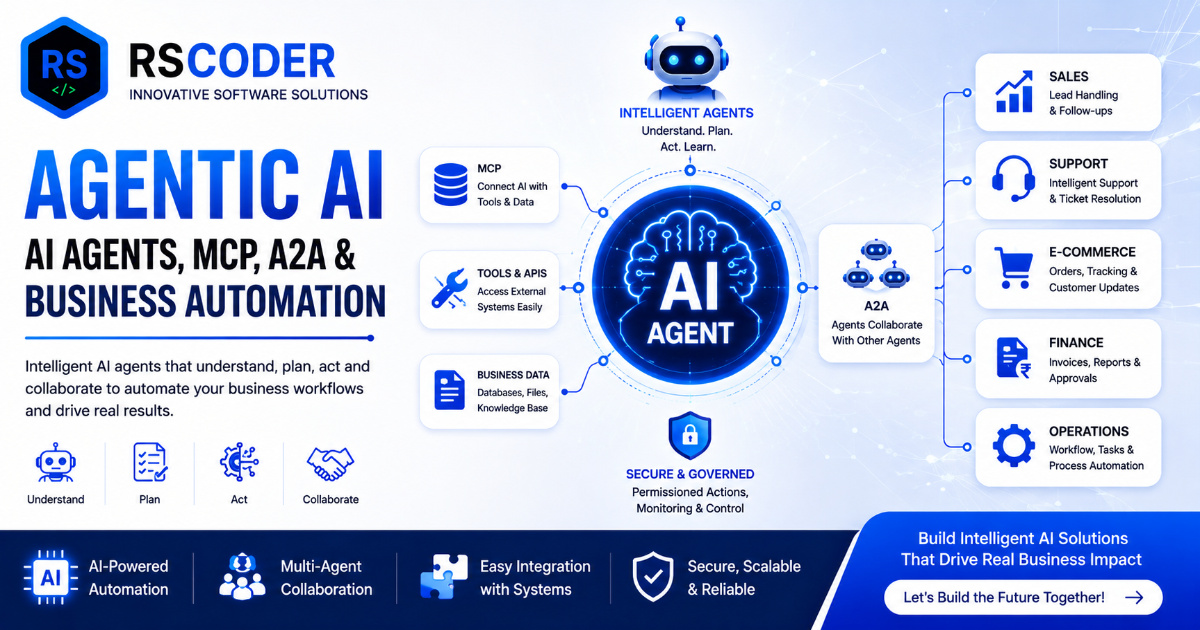
Agentic AI is moving beyond simple chatbots. In 2026, AI systems are increasingly being designed to use tools, access business data, complete multi-step tasks, and collaborate with other AI agents. This shift is creating a new generation of intelligent business software and automation. The rise of standards such as Model Context Protocol (MCP) and Agent2Agent (A2A) is particularly important because they address two different parts of the agent ecosystem: MCP helps AI applications connect with external tools and data, while A2A enables independent agents to discover and communicate with one another. For businesses, this means AI is moving from “answering questions” to “getting work done.” Traditional AI generally responds to a user's request. You ask a question, provide a prompt, and receive an answer. Agentic AI takes a different approach. An AI agent can be designed to: For example, instead of asking an AI assistant: “Give me a sales report.” An agentic system could potentially: Access CRM → collect sales data → analyze performance → identify opportunities → create a report → send it to the sales manager. This is the fundamental difference between an AI assistant and an AI-powered workflow. Google's 2026 developer guidance describes the growing ecosystem around protocols such as MCP and A2A as a way to reduce the custom integration work required when agents interact with tools, data, other agents and applications. Businesses have already experimented with AI chatbots, content generation and AI assistants. The next challenge is turning AI intelligence into business action. Companies want AI systems that can work with: This is where agentic AI becomes commercially interesting. Instead of building isolated AI tools, companies can create connected AI systems capable of participating in real business processes. One of the biggest misunderstandings around AI is treating every conversational system as an AI agent. They are not the same. A chatbot may tell a customer that an order is delayed. An agentic system could potentially check the order system, identify the delay, retrieve shipping information, update the customer, create an internal task and escalate the issue when necessary. The exact level of autonomy should always be controlled by business rules and permissions. MCP stands for Model Context Protocol. It is an open standard designed to connect AI applications with external systems such as data sources, tools and workflows. The official MCP documentation compares it to a standardized connector for AI applications. In simple terms: AI Model → MCP → Tools / Data / Applications For example, an AI agent could potentially use MCP to access: This reduces the need to build a completely separate custom connection for every AI capability. The MCP ecosystem is rapidly evolving. Its July 2026 specification introduced a stateless protocol core, improved routing, caching capabilities, authorization changes, an extensions framework and other improvements aimed at scalability and enterprise use. For developers, this makes MCP an important technology to understand when building modern AI applications. A2A stands for Agent2Agent. While MCP focuses on connecting AI applications with tools and external systems, A2A focuses on communication between independent AI agents. Imagine a business with different specialized agents: Sales Agent → Finance Agent → Inventory Agent → Logistics Agent → Customer Support Agent Instead of forcing one massive AI system to perform everything, specialized agents can communicate and collaborate. Google's A2A specification describes capabilities including agent discovery, task management, collaboration and long-running task updates. This is one of the most important concepts for businesses exploring agentic AI. Connects an AI application or agent to tools and data. Example: AI Agent → MCP → CRM Connects one AI agent with another AI agent. Example: Sales Agent → A2A → Finance Agent A simplified architecture looks like this: BUSINESS AI SYSTEM │ ┌──────▼──────┐ │ AI Orchestrator │ └──────┬──────┘ │ ┌─────────────┴─────────────┐ │ │ MCP Layer A2A Layer │ │ Tools / Data / APIs Agent ↔ Agent │ │ ┌───────┼────────┐ ┌───────┼────────┐ │ │ │ │ │ │ CRM ERP Database Sales Finance Support The important point is that MCP and A2A are complementary rather than direct competitors. Google's developer guidance explicitly presents them as solving different interoperability problems in agentic systems. The biggest opportunity isn't simply creating an AI chatbot. It is connecting AI to actual business workflows. A potential customer fills out a website form. An AI agent can be designed to: That transforms AI from a conversational interface into an operational system. AI agents can support: Agents can: Agentic systems can assist with: AI agents can support: Sensitive financial actions should remain subject to appropriate controls and human approval. Potential applications include: Healthcare implementations require appropriate privacy, security and regulatory controls. AI agents can coordinate: One of the most interesting developments in agentic AI is the rise of multi-agent systems. Instead of asking one AI model to do everything, businesses can create specialized agents. For example: Handles leads and sales activities. Handles customer questions and tickets. Works with approved financial information and workflows. Checks stock and product information. Handles shipment-related workflows. These agents can work independently while communicating through standardized mechanisms. Google has demonstrated multi-agent scenarios where agents built using different languages and components collaborate through A2A. This technology is particularly interesting for businesses with existing software. Imagine connecting agentic AI to: CRM + ERP + HRM + Inventory + Customer Support + Analytics Instead of employees manually moving information between systems, AI-powered workflows can coordinate information and actions across the technology stack. This creates an opportunity for businesses to modernize existing software without completely replacing it. For an IT company like RS Coder, this is where agentic AI connects directly with: Traditional automation usually follows predefined rules. For example: IF payment received → send email. AI automation can handle more flexible information. For example: Understand customer request → identify intent → retrieve information → decide workflow → perform approved actions → generate response. Agentic systems take this further by allowing AI to coordinate multiple steps and tools. However, businesses should not give agents unlimited autonomy. A better architecture is: AI Intelligence + Business Rules + Permissions + Monitoring + Human Oversight More autonomy also creates more responsibility. When AI can access business systems and take actions, companies need to consider: A powerful AI agent without proper controls can become a business risk. Therefore, agentic AI development should focus on controlled autonomy, not unlimited autonomy. A2A itself was designed with security and authentication considerations, while the evolving MCP specification has also added authorization hardening. Not completely. Instead, software is likely to become more AI-native. Traditional software will continue to provide: AI agents can become an intelligent layer that interacts with those systems. The future could therefore look less like: Human → App → Database and increasingly like: Human → AI Agent → Business Systems → Tools → Other Agents with traditional software still operating underneath. Many companies already have software that works. Their problem isn't necessarily: “We need another application.” It may be: “How can we make our existing applications intelligent?” This is where AI Integration Services become valuable. AI can be connected with: RS Coder can help businesses evaluate these systems and identify practical opportunities for AI integration and automation. The competitive advantage won't necessarily come from simply saying: “We use AI.” Almost every business will eventually say that. The bigger question will be: “What can your AI actually do?” Businesses that successfully connect AI with their workflows can potentially reduce repetitive work, accelerate processes and create more responsive customer experiences. This is why the combination of: AI Agents + MCP + A2A + APIs + Automation is becoming an important architectural direction for modern business software. Don't start by trying to automate everything. Start with processes that are: The same task happens frequently. Employees spend significant time completing it. The process relies on information that can be accessed digitally. There are clear business rules and boundaries. You can measure whether automation actually improves the process. Examples include: The direction is becoming clearer. AI is evolving from: Chat → Assistance → Tool Use → Automation → Agents → Multi-Agent Systems MCP is helping establish standardized connections between AI applications and external tools/data, while A2A is designed to help independent agents communicate and collaborate. The MCP project's 2026 roadmap also explicitly identifies agent communication, scalability, governance and enterprise readiness as important areas of development. This doesn't mean every company immediately needs a multi-agent architecture. The right approach is to start with a genuine business problem and select the simplest architecture capable of solving it. At RS Coder, businesses can approach agentic AI as an extension of their existing software ecosystem. Our AI-focused development capabilities can include: The goal isn't to add AI for the sake of following a trend. The goal is to identify where AI can save time, improve workflows, enhance customer experiences and create measurable business value. Agentic AI is one of the biggest shifts happening in software development in 2026. The important change is not simply that AI is becoming more intelligent. AI is becoming increasingly capable of using tools, accessing information, completing tasks, coordinating workflows and communicating with other agents. MCP provides an important connection layer between AI applications and external tools/data, while A2A addresses communication and collaboration between agents. Together with APIs, traditional software and business automation, these technologies can form the foundation of increasingly intelligent enterprise systems. For businesses, the opportunity is clear: Don't just ask AI questions. Start thinking about what work AI can actually perform. And for software companies, the next generation of applications may not simply be AI-powered. They may be AI-native, agentic and connected. What Is Agentic AI?
Why Agentic AI Matters in 2026
AI Agents vs AI Chatbots
Feature
AI Chatbot
AI Agent
Answers questions
✅
✅
Understands natural language
✅
✅
Uses external tools
Sometimes
✅
Accesses business systems
Limited
✅
Performs multi-step tasks
Limited
✅
Executes workflows
Limited
✅
Collaborates with other agents
Rare
✅
Works toward a defined goal
Limited
✅
Can operate autonomously
Limited
✅
Requires governance
Yes
Very important
What Is MCP?
Why MCP Is Important
What Is A2A?
MCP vs A2A: What's the Difference?
MCP
A2A
How Agentic AI Can Automate Business
Example: Automated Lead Management
Agentic AI Use Cases for Businesses
1. Sales Automation
2. Customer Support
3. E-commerce
4. Finance
5. Healthcare
6. Logistics
Multi-Agent AI: The Next Step
Sales Agent
Customer Support Agent
Finance Agent
Inventory Agent
Logistics Agent
Agentic AI for Enterprise Software
Agentic AI and Business Automation
The Importance of AI Governance
Will AI Agents Replace Traditional Software?
Why Businesses Need AI Integration
Why AI Automation Will Become More Important
What Should Businesses Automate First?
Repetitive
Time-consuming
Data-driven
Rule-based
Measurable
The Future of Agentic AI
How RS Coder Can Help Businesses Adopt Agentic AI
Conclusion
Agentic AI in 2026 is transforming software from simple chatbots into intelligent AI agents that can use tools, connect with business systems, automate workflows, and collaborate with other agents through technologies like MCP and A2A. Discover how businesses can use agentic AI to improve productivity, automation, and customer experiences.
Agentic AI in 2026: AI Agents, MCP, A2A & Business Automation