


 Sea Beach
WordPress or Custom Website Development?
Choosing the right website technology is one of the most important decisions for a business planning to build its online presence. Your website is not just a digital visiting card. It can attract customers, generate leads, sell products, automate business processes, and help your brand compete in international markets.
But one question often creates confusion: Should you build your website with WordPress or invest in custom website development?
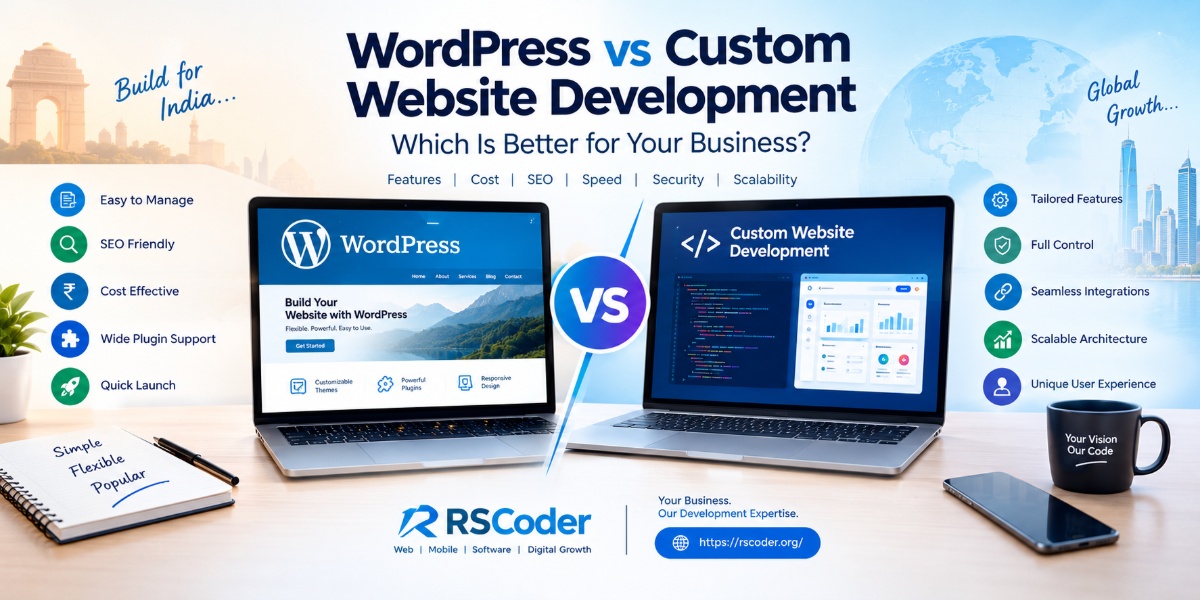
WordPress is popular because it offers ready-made themes, plugins, and a content management system that makes publishing content relatively easy. Custom website development, on the other hand, gives businesses greater control over functionality, integrations, architecture, and user experience.
Neither option is automatically better for every business. The right choice depends on your goals, budget, required features, growth plans, and internal resources.
At RSCoder, businesses can explore website and application development solutions designed around their specific requirements. This guide explains how WordPress and custom development compare so you can make an informed decision.
What Is WordPress Website Development?
WordPress is a content management system (CMS) that allows users to create and manage websites without building every component from scratch.
It is widely used for business websites, blogs, portfolios, news websites, landing pages, and certain eCommerce projects.
WordPress provides a foundation that developers can extend using themes, plugins, custom code, and third-party integrations.
Key benefits of WordPress
-
Easy content management: Update pages, publish blogs, and manage media through an administrative dashboard.
-
SEO capabilities: Use suitable plugins and technical configuration to manage metadata, sitemaps, and other SEO requirements.
-
Flexible design: Customize themes or create a bespoke WordPress theme to match your brand.
-
Extensive ecosystem: Access a large collection of plugins and integrations.
-
Faster initial development: Many standard website features can be implemented without creating them from scratch.
-
Editorial workflows: Make it easier for marketing teams to publish content and maintain website pages.
WordPress is often a practical choice for startups, local businesses, consultants, publishers, service providers, and companies that regularly publish content.
However, using WordPress does not automatically make a website fast, secure, or search-engine friendly. Hosting, implementation quality, plugins, updates, and ongoing maintenance still matter.
What Is Custom Website Development?
Custom website development involves building a website around a business's specific requirements rather than relying primarily on a ready-made website structure.
Depending on the project, developers may use technologies such as HTML, CSS, JavaScript, React, Next.js, PHP, Python, Node.js, databases, APIs, and other frameworks or services.
A custom website can be a simple, lightweight corporate website or a complex digital platform with user accounts, dashboards, booking systems, payment processing, and automated workflows.
Key benefits of custom web development
-
Tailored functionality: Build features around actual business processes.
-
Greater architectural control: Select technologies and structures suited to the project.
-
Flexible integrations: Connect with CRM systems, ERP platforms, payment gateways, APIs, and internal software.
-
Unique user experiences: Design interfaces around specific customer journeys.
-
Scalability options: Plan infrastructure and architecture around expected growth.
-
Control over unnecessary features: Avoid relying on plugins or components that the project does not need.
Custom development can be particularly useful for marketplaces, SaaS products, booking platforms, logistics systems, healthcare portals, and businesses with complex operational requirements.
The trade-off is that custom development generally requires more planning, technical expertise, testing, and ongoing maintenance.
WordPress vs Custom Website Development: Quick Comparison
| Factor | WordPress | Custom Development |
|---|---|---|
| Initial development | Often faster | Depends on complexity |
| Starting budget | Often lower | Often higher |
| Content management | Available by default | Must be selected or developed |
| Design flexibility | High with suitable customization | Very high |
| Special business logic | May require custom code or plugins | Can be built around requirements |
| SEO | Strong when implemented correctly | Strong when implemented correctly |
| Website speed | Depends on hosting, themes, and plugins | Depends on architecture and implementation |
| Integrations | Plugins, APIs, and custom code | APIs and tailored integrations |
| Maintenance | Updates, backups, compatibility, security | Code, dependencies, infrastructure, security |
| Best fit | Content-led and standard business websites | Complex platforms and tailored workflows |
The important point is that the development approach alone does not determine the quality of the final website. A poorly developed custom website can perform worse than a well-optimized WordPress website.
1. Development Cost: Which Option Is More Affordable?
Website development cost is one of the first considerations for startups and established companies.
WordPress projects can be more affordable initially because developers can use an existing CMS, established themes, and suitable plugins. A straightforward company website may therefore require less development time than an equivalent custom-built solution.
Custom website development usually involves additional work in requirements analysis, interface design, architecture, development, testing, and integrations. More complex functionality can increase both the initial investment and the time required to launch.
However, the cheapest initial build is not necessarily the cheapest long-term solution.
Consider a business that starts with a basic website but later needs customer accounts, advanced booking, automated reporting, and integrations with internal systems. Depending on its original setup, extending WordPress may be appropriate, or a custom platform may offer a better long-term fit.
What should you compare?
Evaluate the total cost of ownership, including:
-
Initial design and development
-
Hosting and domain renewal
-
Paid themes, plugins, or third-party services
-
Security updates and backups
-
Feature upgrades and integrations
-
Technical support and ongoing maintenance
For an accurate budget, define your required pages, functionality, integrations, and support expectations before requesting a proposal.
RSCoder : Planning a new business website? Contact RSCoder through ww.rscoder.org to discuss your requirements and explore a development approach aligned with your goals.
2. SEO: Is WordPress Better Than Custom Development?
Both WordPress and custom-built websites can rank on Google. Search visibility depends on how well the website meets user needs and how effectively it is designed, developed, and maintained.
WordPress offers a convenient starting point for many SEO tasks. Depending on the setup, you can manage page titles, meta descriptions, URLs, sitemaps, headings, image descriptions, and redirects using built-in features, plugins, or custom configuration.
Custom development can provide precise control over technical SEO, structured data, page templates, rendering, URL architecture, and performance. However, developers must implement these elements correctly.
Essential SEO factors for both platforms
-
Search intent: Create useful content that answers the query visitors are searching for.
-
Page speed: Optimize images, code, caching, and server response.
-
Mobile usability: Make navigation and content work across different screen sizes.
-
Technical SEO: Configure crawlability, indexing, canonical URLs, redirects, and XML sitemaps.
-
Content structure: Use descriptive headings, internal links, and clear page organization.
-
Structured data: Add relevant schema markup where appropriate.
-
Conversion experience: Help visitors take meaningful actions without unnecessary friction.
For businesses targeting India and international markets, website architecture and content planning are particularly important. Service pages should reflect the needs of the target audience, while localized content should offer genuine regional relevance rather than duplicate pages with only city names changed.
Verdict: WordPress is convenient for content-heavy SEO campaigns. Custom development is equally capable of supporting SEO when technical implementation and content management are handled properly.
3. Website Speed and Performance
A slow website can frustrate visitors, increase abandonment, and undermine the user experience.
WordPress performance depends on hosting, theme quality, plugins, database queries, image sizes, caching, and code optimization. A lightweight WordPress website can perform very well, while an overloaded site may become slow.
Custom development gives developers more freedom to control page rendering, assets, caching, data requests, and application architecture. However, custom code does not guarantee better performance. Poorly optimized JavaScript, oversized media, inefficient database queries, and weak infrastructure can slow any website.
For both approaches, prioritize:
-
Responsive image formats and appropriate image sizes
-
Efficient JavaScript and CSS delivery
-
Browser and server-side caching where suitable
-
Reliable hosting and content delivery
-
Minimal unnecessary third-party scripts
-
Real-user performance monitoring
Measure performance using tools such as Google PageSpeed Insights and Search Console rather than selecting a platform based on assumptions.
4. Security and Website Maintenance
Website security is essential whether you run a small business website or a global digital platform.
WordPress requires timely core, theme, and plugin updates. Poorly maintained extensions, weak passwords, excessive permissions, and insecure hosting can create vulnerabilities.
Custom-built websites also need security reviews, dependency updates, access controls, backups, monitoring, and secure deployment practices. Their risk profile depends on the codebase, infrastructure, and development process.
A responsible security plan should include:
-
HTTPS and secure configuration
-
Regular backups and tested recovery procedures
-
Strong authentication and appropriate user permissions
-
Updates for software and dependencies
-
Input validation and secure handling of user data
-
Monitoring, logging, and incident-response procedures
If your website processes payments, personal information, medical records, or business-critical data, plan security and compliance requirements before development begins.
5. Customization and Business-Specific Features
WordPress can support a wide range of business requirements through plugins, integrations, themes, and custom development. It should not be treated as a platform limited to blogs.
However, the more a website depends on unusual workflows or complex application logic, the more important architecture becomes.
For example, a standard company website might need service pages, contact forms, testimonials, and a blog. WordPress may handle this efficiently.
A logistics platform may need live shipment tracking, role-based dashboards, carrier integrations, automated notifications, and reporting. A healthcare platform may require appointment management, staff workflows, controlled access, and integration with other systems.
These projects may benefit from custom development, a suitable application framework, or a hybrid architecture that combines a CMS with custom-built services.
The best choice is the one that meets the requirements without introducing unnecessary complexity.
6. Scalability: Which Website Is Better for Future Growth?
Scalability is not simply about having more website visitors. It can also mean supporting more products, customers, transactions, integrations, and business processes.
WordPress can scale when hosting, caching, database performance, content delivery, and application design are appropriate. Many businesses can operate successfully on WordPress for years.
Custom development allows the technology architecture to be designed around anticipated workloads and specialized features. That flexibility can be valuable for SaaS platforms, marketplaces, and high-volume applications.
However, custom systems also require ongoing engineering investment. An architecture designed for hypothetical future traffic may cost more than necessary today.
Before choosing, estimate realistic traffic, growth expectations, data requirements, and the complexity of future features.
7. Which Is Better for eCommerce Websites?
The right option depends on your product catalog, checkout requirements, integrations, and operational complexity.
WordPress with WooCommerce can be suitable for many small and medium-sized online stores. It provides product management, order workflows, and an ecosystem of extensions.
Custom eCommerce development may be a better fit when a business needs unusual pricing rules, complex product configurations, multi-vendor workflows, specialized inventory systems, or deep integration with enterprise software.
A custom solution is not automatically superior, and a plugin-based store is not automatically limited. Compare the actual requirements, ongoing operating costs, security responsibilities, and customer experience.
For international eCommerce, also consider supported currencies, tax rules, shipping regions, payment methods, accessibility, and localization.
8. WordPress vs Custom Development for Businesses in India and Worldwide
Indian startups and small businesses often prioritize affordability, quick launches, and the ability to manage content without relying on developers for every update. WordPress can meet these needs for many standard websites.
Growing companies may need custom integrations, customer portals, booking systems, or internal dashboards. These requirements can justify custom development or a hybrid solution.
For businesses targeting international customers, the decision should also account for multilingual content, regional performance, accessibility, privacy obligations, and local payment or delivery integrations.
The same principle applies worldwide: select the technology based on the audience and business model, not simply because a platform is popular or new.
WordPress remains widely used across the web. W3Techs tracks its usage in its website technology surveys, providing useful context about its adoption. Popularity, however, is not proof that it is the right choice for every individual project.
9. WordPress vs Custom Website Development: Which Should You Choose?
Choose WordPress if you need:
-
A company profile or service website
-
A blog, publication, or content-focused website
-
Landing pages for marketing campaigns
-
A manageable website for a startup or small business
-
An online store that fits a suitable existing platform and extension ecosystem
Consider custom website development if you need:
-
A unique web application or SaaS product
-
Advanced booking or workflow automation
-
Complex user roles and customer dashboards
-
Specialized marketplace functionality
-
Deep integration with internal software or multiple APIs
-
A carefully tailored application architecture
Consider a hybrid approach if you want the editorial convenience of WordPress alongside custom-built functionality. For example, a company might manage its blog and marketing pages through WordPress while operating a separate custom application for customer accounts.
The final decision should follow a requirements assessment rather than a blanket preference for either technology.
How RSCoder Can Help With Your Website Development
Choosing a platform is only one part of building a successful digital presence. The website also needs a clear strategy, thoughtful user experience, reliable development, technical SEO, and a plan for ongoing improvement.
RSCoder provides website and app development and digital marketing services to help businesses plan digital solutions around their goals.
Whether you need a WordPress business website, a custom web application, an eCommerce platform, API integrations, or a broader digital growth strategy, start by defining what the website must achieve.
A practical development process includes:
-
Understanding your business goals and target customers.
-
Identifying the pages, features, and integrations you need.
-
Selecting an appropriate technology and architecture.
-
Designing a responsive, user-friendly experience.
-
Building and testing the website for functionality, security, and performance.
-
Planning SEO, analytics, maintenance, and future improvements.
Ready to plan your next website?
Visit www.rscoder.org to connect with RSCoder and discuss a website development solution suited to your business.
Frequently Asked Questions
1. Is WordPress better than custom website development?
WordPress is often a practical choice for content-led websites, company profiles, blogs, and standard business websites. Custom development may be more suitable for complex applications, specialized workflows, and tailored integrations. The better option depends on your requirements.
2. Which is cheaper: WordPress or custom website development?
WordPress projects are often cheaper initially because they can reuse an existing CMS, themes, and plugins. Custom development may require more engineering time. Long-term cost depends on maintenance, licensing, infrastructure, feature changes, and support.
3. Is WordPress good for SEO?
Yes. WordPress supports effective SEO when configured correctly. Content quality, site architecture, crawlability, page speed, mobile usability, and technical implementation matter more than the CMS alone.
4. Are custom websites faster than WordPress websites?
Not necessarily. Custom websites offer greater control over implementation, but both approaches can perform well or poorly. Hosting, code quality, images, scripts, caching, and database performance all influence speed.
5. Can a WordPress website handle eCommerce?
Yes. WordPress with WooCommerce can support many online stores. Complex marketplaces, specialized checkout flows, or unusual integrations may require custom extensions or a different architecture.
6. Is custom website development suitable for startups?
Yes, when the startup's product or business model requires unique functionality. A startup with a simple marketing website may be better served by WordPress, while a software startup building a web application may need custom development.
7. Can WordPress websites scale as a business grows?
Yes. With suitable hosting, caching, database optimization, and careful development, WordPress can support substantial growth. More complex requirements may call for custom services or a hybrid architecture.
8. How do I choose a website development company?
Review relevant project experience, technical capabilities, communication, project scope, testing practices, maintenance arrangements, and ownership terms. Ask how the company will address performance, security, SEO, and future upgrades.
9. Which is better for a business targeting international customers?
Either can work. Consider multilingual content, accessibility, regional performance, payment requirements, privacy obligations, and integration needs when selecting the platform.
10. Should I choose WordPress or custom development for my business?
List your essential features, budget, content requirements, integrations, and expected growth. Compare the total cost of ownership and choose the simplest reliable architecture that meets your current and reasonably anticipated needs.
Final Verdict
WordPress is a strong choice for many standard business websites, while custom website development is valuable when a business needs specialized functionality and greater architectural control.
Neither approach guarantees better SEO, faster loading, stronger security, or higher conversions. Those results depend on the quality of the planning, design, development, and ongoing optimization.
Before making a decision, evaluate your business goals, technical requirements, budget, and long-term plans.
If you need guidance choosing between WordPress and a custom solution, RSCoder can help you explore the right website and application development approach for your business.
Visit https://rscoder.org/ to get started.
Should you choose WordPress or custom website development? Compare features, costs, SEO, performance, flexibility, and scalability to find the right solution for your business in India and global markets.
WordPress vs Custom Website Development: Which Is Better in 2026?