

 Sea Beach
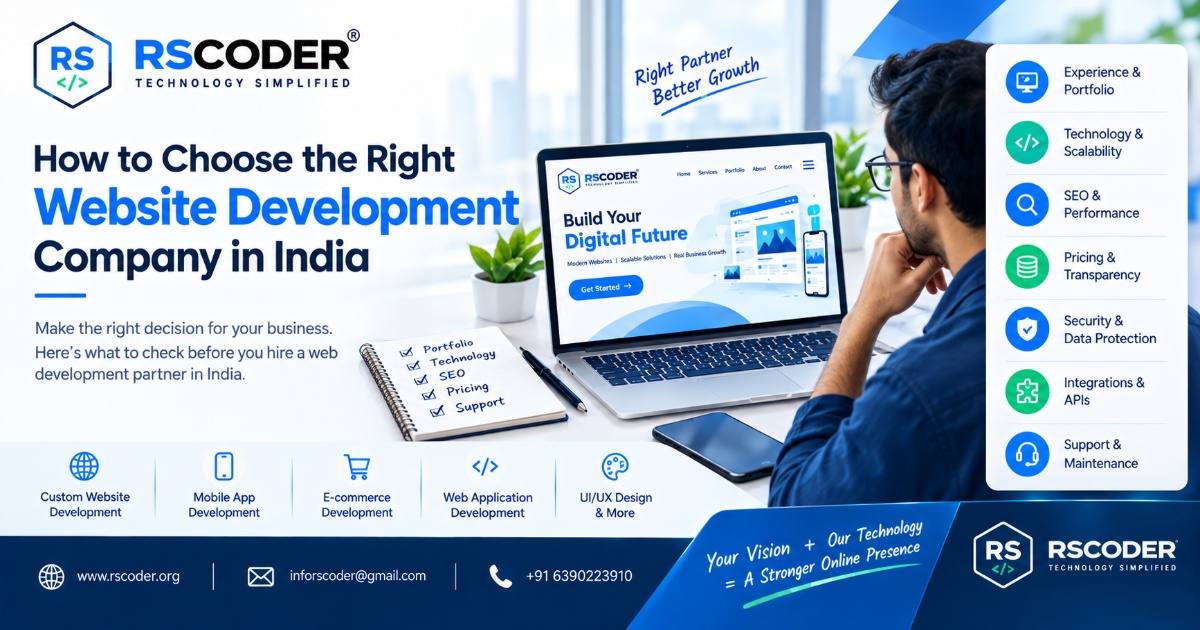
Choosing a website development company in India is no longer simply about finding someone who can design attractive pages.
Your website can become your primary digital sales channel, lead-generation platform, customer-support touchpoint and connection to other business systems. The development partner you select can therefore affect your website's performance, security, scalability, search visibility and long-term maintenance.
With thousands of agencies, freelancers and development companies offering web services in India, comparing them can be difficult. Recent 2026 industry guides consistently emphasize checking live portfolios, project scope, technology, ownership, SEO, testing, communication and post-launch support rather than choosing a provider only because of its price.
Why Choosing the Right Website Development Company Matters
A website may look good in a presentation but still perform poorly after launch.
Problems such as slow loading, poor mobile usability, weak technical SEO, difficult content management, security vulnerabilities or unclear ownership can become expensive to fix later.
Before selecting a company, think beyond the initial website design.
Ask:
- Will the website support my business goals?
- Can it generate enquiries and leads?
- Is it mobile-friendly?
- Can it be optimized for Google and AI-powered search?
- Is the technology suitable for future growth?
- Can it integrate with CRM, ERP, payment gateways or APIs?
- Who owns the website and source code?
- What support will be available after launch?
These questions help you evaluate the complete development partnership, not simply the appearance of the homepage.
1. Start With Your Business Requirements
Before contacting website development companies, define what you actually need.
A simple business website, an e-commerce platform and a custom web application require very different development approaches.
Your requirements might include:
- Corporate website
- Business website
- E-commerce website
- Custom web application
- Booking platform
- Real estate portal
- Education platform
- Healthcare website
- Customer portal
- SaaS application
- API-connected website
- AI-powered website
Write down your objectives, target customers, required pages, functionality and integrations.
A clear requirement makes it easier to receive accurate proposals and compare different companies.
2. Check Their Real Portfolio
A portfolio is one of the first things you should investigate.
But don't only look at screenshots.
Ask for live website URLs and explore them yourself on desktop and mobile. Recent 2026 guidance from several Indian development companies recommends checking actual live work because screenshots cannot demonstrate real-world performance, responsiveness or maintenance quality.
Look at:
- Website speed
- Mobile responsiveness
- Navigation
- Design quality
- Contact forms
- User experience
- Content structure
- Functionality
- Search visibility
- Overall usability
Also ask what part of each project the company actually handled.
A genuine portfolio should help you understand the developer's experience, not simply display attractive designs.
3. Look for Experience Relevant to Your Industry
Every business has different requirements.
For example, an e-commerce business may require:
Product management + payment gateway + inventory + orders + shipping
A hospital may need:
Appointments + doctors + patients + pharmacy + laboratory + reports
An educational institution may need:
Admissions + students + teachers + fees + attendance + examinations
Therefore, don't select a development company only because it has built many websites.
Look for experience with projects similar to yours.
A company that understands your industry can often identify functionality and workflow requirements earlier in the project.
4. Ask Which Technology They Recommend — and Why
Technology should be selected according to the project rather than simply following the latest trend.
Depending on requirements, a company may recommend technologies such as:
- WordPress
- Shopify
- Laravel
- PHP
- React
- Next.js
- Node.js
- Python
- Custom APIs
- Cloud platforms
- Headless CMS
There is no single technology that is automatically correct for every website.
The important question is:
Why is this technology suitable for my project?
A professional development company should be able to explain the technology, scalability, maintenance requirements and future possibilities in language that a business owner can understand.
5. Make SEO Part of Development From the Beginning
SEO should not be treated as something added after the website has been completed.
Your website's architecture can affect how search engines understand and discover your content.
A development company should consider:
- Clean URLs
- Mobile responsiveness
- Page speed
- Proper heading structure
- Metadata
- XML sitemap
- Canonical URLs
- Structured data where appropriate
- Image optimization
- Internal linking
- Crawlability
- Indexability
- Core Web Vitals
Google continues to recommend focusing on overall page experience and strong technical foundations while following its SEO guidance.
For businesses in 2026, it is also useful to think beyond traditional search.
Your content and website structure should be understandable to both search engines and AI-powered discovery systems.
6. Check Mobile Experience Carefully
A website can look excellent on a desktop and still provide a poor experience on smartphones.
Before selecting a developer, test their portfolio using different screen sizes.
Check:
Can visitors read the content easily?
Are buttons easy to tap?
Does the menu work properly?
Do forms work on mobile?
Do images and sections resize correctly?
For many businesses, mobile users represent a significant part of website traffic, so responsive development should be considered a basic requirement rather than an optional feature.
7. Don't Compare Companies Only on Price
This is one of the biggest mistakes businesses make.
You may receive three proposals:
Company A: ₹30,000
Company B: ₹80,000
Company C: ₹1,50,000
At first glance, the cheapest proposal may look attractive.
But the proposals may include completely different things.
One might include:
- Design
- Development
- SEO structure
- Testing
- Hosting setup
- Security
- Support
- Multiple revisions
Another may include only design and basic development.
Therefore, compare scope before price.
Ask each company to clearly specify:
- Number of pages
- Features
- Technology
- Design
- Content responsibility
- SEO work
- Hosting
- Domain
- Integrations
- Revisions
- Testing
- Launch
- Maintenance
- Support
Recent 2026 website-development guides specifically highlight the importance of comparing the written scope and recurring costs rather than simply comparing the headline price.
8. Confirm Website and Source-Code Ownership
This is an important question that many businesses forget to ask.
Before signing an agreement, clarify:
Who owns the domain?
Who controls the hosting account?
Will you receive the website source code?
Who owns custom designs and content?
Can another developer maintain the website later?
These details should be documented in your agreement.
Clear ownership and handover terms can reduce problems if you later change developers, migrate hosting or expand the website.
9. Ask About Security and Testing
A website should not simply be designed and published.
It should be tested before launch.
Ask whether the development process includes:
- Form validation
- Authentication testing
- Security checks
- Broken-link testing
- Browser testing
- Mobile testing
- Performance testing
- Backup configuration
- Database protection
- Error handling
- SSL/HTTPS configuration
For websites handling customer information, payments or business data, security becomes even more important.
India's expanding digital economy is also increasing the importance of cybersecurity resilience, secure architecture and recovery planning.
10. Understand Their Development Process
A professional website project should have a defined process.
A typical workflow may look like:
Requirement → Planning → UI/UX Design → Development → Testing → SEO Setup → Client Review → Launch → Support
Ask the company:
- Who will manage the project?
- How often will you receive updates?
- How will revisions be handled?
- How will additional requirements be handled?
- Who performs testing?
- How will the final launch happen?
A clearly explained process can reduce misunderstandings and scope problems later.
11. Don't Forget Post-Launch Support
Launching the website is not necessarily the end of the project.
You may later need:
- Security updates
- Bug fixes
- Content changes
- New pages
- New integrations
- Performance improvements
- Backup management
- SEO improvements
- New features
- AI integrations
Ask what support is available after launch and whether maintenance is included or separately charged.
A development partner that can support the website after launch can be useful when your business grows and requirements change.
12. Ask About APIs and Integrations
Modern websites rarely operate completely independently.
Your website may need to connect with:
CRM + ERP + Payment Gateway + WhatsApp + Email + Analytics + Inventory + Shipping + AI + Other APIs
If your business expects to add integrations later, discuss this before development begins.
An API-ready architecture can make it easier to connect your website with other business systems as requirements evolve.
13. Look for AI-Ready Development
AI is becoming part of modern websites and business applications.
Depending on the project, you may consider:
- AI chatbots
- AI customer support
- AI search
- AI recommendation systems
- AI content assistance
- AI lead qualification
- AI document processing
- AI-powered personalization
- AI agents
- Automated workflows
However, AI should solve a real business problem rather than simply being added because it is popular.
The right development company should be able to explain where AI creates practical value for your website.
14. Check Communication Before You Sign
Technical ability is important, but communication can strongly affect the project experience.
Ask:
- Who is my main contact?
- How quickly are questions answered?
- How are project updates shared?
- Can I speak directly with the development team?
- How are changes documented?
You want a company that understands your business requirements rather than simply taking a list of technical instructions.
Why Businesses Choose RS Coder for Website Development
At RS Coder, we approach website development as more than simply creating pages.
We build digital platforms around business objectives, customer journeys and future growth.
Our website development capabilities can include:
- Custom Website Development
- Business Website Development
- E-commerce Development
- Web Application Development
- Mobile App Development
- UI/UX Design
- API Integration
- CRM & ERP Integration
- Payment Gateway Integration
- AI Integration
- SEO-Friendly Website Architecture
- Website Maintenance & Support
Whether you need a professional corporate website, e-commerce platform, custom web application or an AI-ready digital platform, the development approach should begin with understanding your business.
Your website should be built around your business — not the other way around.
🌐 www.rscoder.org
📧 inforscoder@gmail.com
📞 +91 6390223910
Final Checklist Before Choosing a Website Development Company
Before signing your project, ask these 10 questions:
| Question | Why It Matters |
|---|---|
| Can I see live projects? | Verifies actual experience |
| Have you built similar websites? | Shows relevant expertise |
| What technology will you use? | Helps assess scalability |
| Is SEO included in development? | Supports search visibility |
| Is the website mobile responsive? | Improves mobile experience |
| Who owns the source code? | Protects your investment |
| What exactly does the quotation include? | Prevents scope confusion |
| How is the website tested? | Reduces launch problems |
| What happens after launch? | Clarifies support |
| Can you integrate APIs and future AI features? | Supports long-term growth |
Conclusion
Choosing the right website development company in India should not be based on a beautiful portfolio or the lowest quotation alone.
Look at the complete picture: experience, technology, SEO, performance, security, ownership, communication, development process, integrations and long-term support.
The right development partner should understand where your business is today and help build a website that can support where your business wants to go tomorrow.
Ready to build a modern website for your business?
Build Your Next Website With RS Coder
🌐 www.rscoder.org
📞 +91 6390223910
📧 inforscoder@gmail.com
Learn how to choose the right website development company in India by comparing experience, portfolio, technology, SEO, pricing, security, support, and scalability.
How to Choose the Right Website Development Company in India